October 3, 2026
When an Affiliate's Conversion Rate Is Too Good to Be True
The number everyone wants to go up
Conversion rate is usually one of the first things people check when they review an affiliate. It is simple, it moves, and it seems to answer the only question that matters: is this traffic working?
So when an affiliate's rate climbs, the natural reaction is to be pleased. Sometimes that is exactly right. A better landing page, a sharper audience or a new placement can all lift conversion for good reasons. But in a program that pays per lead, a rising conversion rate is also what fabricated traffic looks like from the outside. The skill is not distrusting good news. It is knowing which questions to ask before you pay for it.
Why real traffic has a ceiling
Real people are messy. They land on a page, get distracted, decide the offer is not for them, balk at a phone number field, or close the tab halfway through the form. That friction is why conversion rates for genuine traffic settle into a range and tend to stay there. Improving them takes real work, and the improvement is usually modest and gradual.
Automated or fabricated traffic has no such friction. A script told to submit a form submits it, cleanly, every time. So the conversion rate attached to fabricated volume can look spectacular, and it can look spectacular immediately. When a number looks too good, the useful question is what removed the friction.
Compare against peers, not just against last week
A rate is only high or low relative to something. Two comparisons matter, and they catch different problems.
The first is the affiliate against its own history. An overnight move from 3 percent to 9 percent with no explanation is easy to spot this way.
The second is the affiliate against other affiliates running the same offer. This catches the slower version of the same problem. A source that ramps up cautiously, nudging its rate up a little each week, can pass a "compared with last week" check every single time, because each step looks small. Against a peer group running comparable traffic, the same affiliate may stand out clearly after a month.
Neither comparison is a verdict. Different traffic sources legitimately convert at different rates, and search, email, social and native placements all behave differently. The point of a peer comparison is to put the number in context, not to treat the average as the target.
The shape of the change
Look at how the rate moved, not only where it ended up.
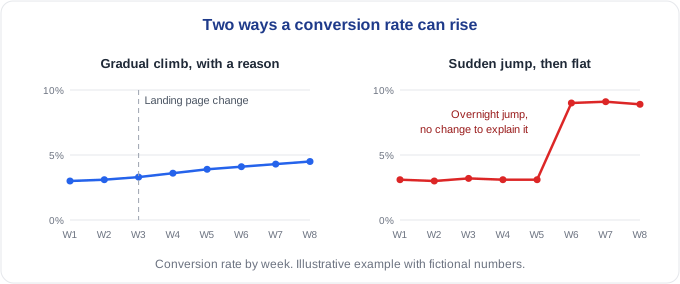
Genuine improvement usually has a story and a shape. The left chart shows a rate that climbs gradually after a landing page change. It rises over several weeks, has ordinary wobble in it, and lines up with something you can point to. The right chart shows a jump that arrives in a single step, with no change that explains it, and then sits almost perfectly flat at the new level. Real traffic rarely holds a new level that steadily, because real audiences fluctuate from day to day and week to week.
Neither shape is proof. Occasionally a rate really does jump overnight: a large placement goes live, or an email goes out to a warm list. But an abrupt step with no explanation, followed by unusual steadiness, is the combination worth checking before you pay for it.
Look at what happens after the lead
Conversion rate is measured at the moment of submission. A lead is only worth something if it goes on to be reached, qualified and sold. That makes the downstream numbers the best test of whether a high conversion rate is real.
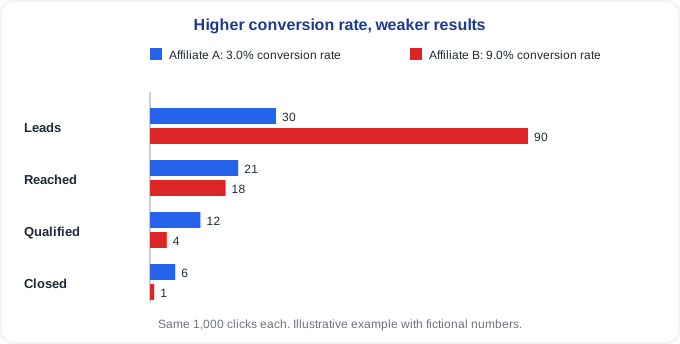
In the example, both affiliates send the same number of clicks. Affiliate B converts three times as many of them, which looks like a clear win. But fewer of B's leads can be reached, and almost none become customers. Per click, Affiliate A is worth far more despite the lower rate.
If you can get this data back from your sales or intake team, track contact rate and close rate by affiliate and by week. A conversion rate that climbs while the contact rate falls is one of the clearest signs that volume is being counted without being real.
Why lead gen is more exposed than e-commerce
In a pay-per-sale program, faking a conversion means faking a purchase, which costs money and leaves payment records behind. In a pay-per-lead program the bar is much lower. A form has to be filled in with plausible details, and producing those costs a fraudster almost nothing. It also makes inflated conversion rates easy to overlook, because "more leads" sounds like good news until someone checks what became of them.
Rule out the dull explanations first
Before treating a spike as fraud, rule out the ordinary causes. A few of them account for a lot of spikes.
- A tracking change on your side. A conversion pixel that fires twice, a postback that was added twice, or a tag change can count the same lead more than once.
- A change to the offer or landing page. A simpler form, a stronger headline or a new incentive can raise the rate for real.
- A shift in traffic mix. More volume from a high-intent source can lift the rate without anything being wrong.
- A small sample. An affiliate with a few dozen clicks can swing wildly. A rate built on little data tells you very little.
- A repair to earlier under-reporting. If tracking was broken before, fixing it can make the rate look like it jumped.
Checking your own setup first also protects the relationship. Accusing an affiliate of a problem that turned out to be a pixel firing twice on your side is an expensive mistake.
Three questions to work through
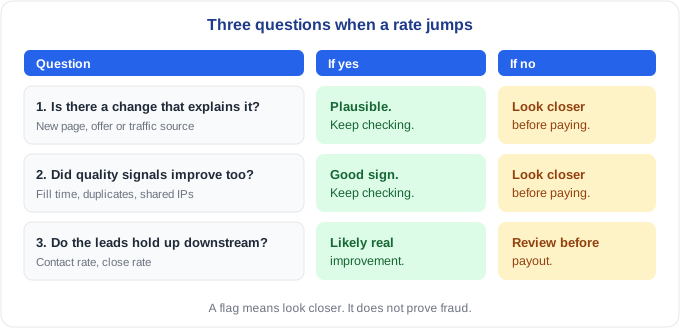
When a rate jumps, work through the questions above in order. Is there a change that explains it? Did the quality signals move the right way too, meaning fewer duplicates, normal form completion times, and no cluster of leads sharing an IP address? And do the leads hold up once your team starts working them?
If the answer to the first or second is no, look closer before paying. If the third is no, review the leads before the payout goes out. None of this needs a fraud team. It needs the export, a little history and a few minutes.
What to do before the next payout
You do not have to choose between paying in full and refusing. A middle path works for most programs.
- Pay the affiliate's normal baseline volume as usual.
- Hold the unexplained excess for a short review.
- Ask the affiliate a specific, neutral question: what changed in your traffic this week?
- Check the held leads for the usual patterns: duplicates, very fast form completion, shared IP addresses.
- Write down what you found, whatever the outcome.
A good affiliate will usually have a ready answer and often welcomes the question. An affiliate with no explanation for a sudden jump is telling you something too.
The checking is the slow part. If you would like a second set of eyes, send us a recent lead export and we will run every lead through our checks and email you a report showing which ones look suspicious and why, at no cost. A flag means a lead deserves a closer look. The decision stays with you.
Frequently asked questions
What conversion rate counts as normal for a CPA offer? There is no universal figure. It depends on the vertical, how demanding the form is and where the traffic comes from. That is why comparing an affiliate with its own history and with peers on the same offer is more useful than any fixed benchmark.
Can a legitimate affiliate have a much higher rate than its peers? Yes. Better targeting, a more qualified audience and strong creative can all do it. A high rate is a reason to look, not a conclusion.
How much data do I need before judging a rate? Enough clicks that the number is stable. A rate calculated on a few dozen clicks can swing widely in either direction, so wait for a reasonable sample before drawing conclusions, and compare with peers only once you have one.
Should I stop paying an affiliate whose rate jumps? Not automatically. Treat the jump as a prompt to review the leads and ask a question. Pay baseline volume, hold the unexplained excess for review, and decide once you have looked.
A conversion rate tells you how often people finished the form. It cannot tell you whether the people were real.