October 3, 2026
The Tell-Tale Sign of a Bot Lead: It Converts Too Fast
A form has a floor
A fabricated lead can fake plenty of things. It can have a believable name, a plausible address and an email that passes validation. What it struggles to fake convincingly is time.
A person completing a lead form has to load the page, read the offer and type into each field. Even a fast, practiced typist cannot do that instantly. There is a floor under how quickly a real first-time visitor can finish, and the floor rises with every field you add.
A script has no such floor. It can submit a form as quickly as the page allows, sometimes in a fraction of a second, because it never reads anything and never types anything. That difference is the basis for one of the most useful checks in lead-gen fraud review: how long did this conversion take?
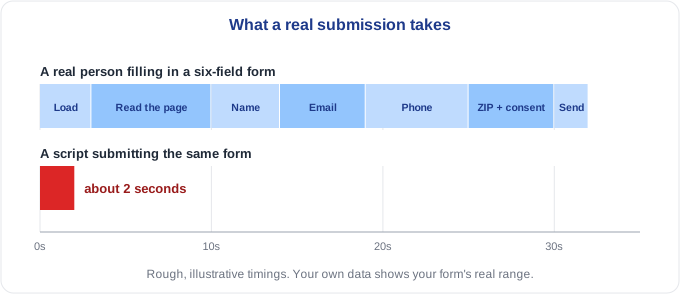
The timings above are rough illustrations for a six-field form, not measurements of yours. What matters is the shape. A real submission is a series of small human tasks that add up to tens of seconds, and a script skips all of them.
What fast conversions look like in an export
Most trackers record the time of the click and the time of the conversion. The gap between them is time-to-convert. It includes the page loading, the visitor reading and the form being filled in, so it runs slightly longer than pure typing time but tracks it closely.
Plot that gap across a source's leads and the difference between real and scripted traffic tends to be easy to see.
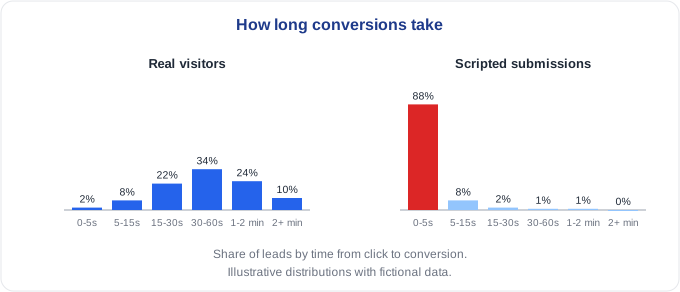
Real visitors produce a wide spread: a few quick ones, a hump in the middle and a long tail of people who wandered off and came back. Scripted submissions pile up in a narrow spike at the very start. If an affiliate's chart looks like the right-hand panel, you do not need a sophisticated model to see that something is off. The numbers here are fictional, but the contrast is typical of what the two kinds of traffic look like.
Why one fast lead proves nothing
Be careful with this signal, because a single fast conversion has several innocent explanations. Browser autofill can fill half a form in a tap, especially on mobile. A returning customer may know the form by heart. A form that was shortened last week legitimately has a lower floor than it did before.
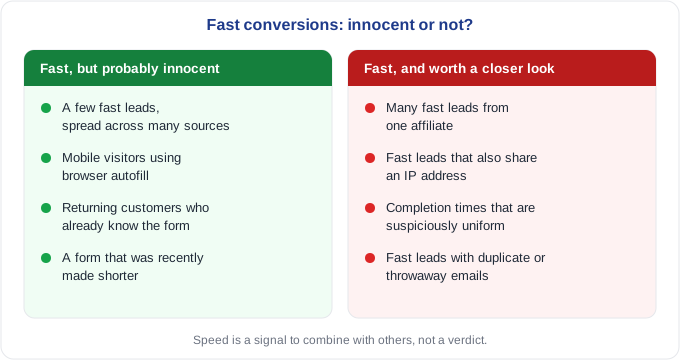
That is why the useful question is not whether a lead was fast, but whether a source is producing many fast leads and what else is true of them. A handful of quick leads scattered across many sources is ordinary. A cluster of them from one affiliate, sharing an IP address and using throwaway email addresses, is a different story.
Fast is one tell, uniform is another
More careful fraud operations know that a two-second completion looks bad, so they add artificial delays. That raises the bar, but it often creates a second giveaway. A delay that is randomized within a narrow band, or fixed at one value, produces completion times that are far more alike than a real audience's would be. People vary. Some take twenty seconds, some take ninety, and some take four minutes because the phone rang.
So look at two things together: whether completion times are unrealistically short, and whether they are unrealistically similar. A source whose conversions all land between 11 and 13 seconds, over and over, deserves as much suspicion as one that finishes in two.
Set a baseline for your own form
There is no single cutoff that works for every form. A two-field signup and a twelve-field mortgage application have very different realistic minimums. You can establish yours from your own data.
- Export a recent month of conversions that includes both click time and conversion time.
- Work out the time-to-convert for each lead.
- Look at the shape of the distribution, and note how fast the quickest few percent are among your better-performing, longer-running sources.
- Do this separately for desktop and mobile if you can, since autofill changes the floor.
- Revisit it whenever you change the form. A shorter form lowers the floor, and an old baseline will then start flagging real leads.
A baseline built this way is specific to your offer, which is what makes it useful. A generic cutoff is likely to flag genuine mobile leads while missing slower scripts.
When your funnel changes the math
Not every funnel behaves like a simple single-page form, and the baseline should reflect that. A multi-step form or a quiz has a higher floor, because there are more screens to read and more answers to give. A form that is pre-filled from details already in the URL, or from an earlier step on your site, has a much lower one. If visitors pass through a pre-lander or an extra redirect before they reach the form, the gap between click and conversion includes that journey as well.
The reverse also happens. Some real leads take hours or days, because someone clicked, closed the tab and came back that evening. Long gaps like that are normal and are not a concern by themselves. What you are looking for is a source whose gaps are consistently far shorter than your own genuine traffic allows, not a lead that merely took longer than expected.
Why this matters most in high-CPL verticals
The incentive to fabricate scales with the payout. Solar, legal, insurance and financial leads pay well enough per lead that a script that costs almost nothing to run is worth operating. When each lead is worth real money, even a small share of scripted submissions adds up over a quarter, and it adds up quietly because each one looks like an ordinary lead.
What to do when you find the pattern
Speed rarely travels alone. When you find a source with unusually fast completion times, check the same leads for the other common signs: duplicate or near-duplicate submissions, many different leads sharing one IP address, throwaway or auto-generated emails, and submissions that arrive at suspiciously even intervals. Several signals together make a far stronger case than any one of them. Then:
- Hold the payout on the flagged leads while you review them.
- Ask the affiliate about the traffic source.
- Keep a record of the pattern, the leads and the dates.
- Treat the score as a reason to look, not a verdict.
Checking time-to-convert by hand across a large export is tedious, which is why it is so often skipped. If you would like to see how your own traffic looks, send us a recent lead export and we will check every lead, including how quickly each one was completed, and email you a report of what looks suspicious and why, at no cost.
Frequently asked questions
How fast is too fast for a lead form? It depends on the form. A two-field form has a much lower floor than a long application. Measure the realistic range from your own better traffic sources, and treat anything far below it, especially in clusters, as worth reviewing.
Can autofill make a real lead look like a bot? Yes. Autofill can cut completion time sharply, particularly on mobile. That is why a single fast lead is weak evidence and a pattern across one source is strong evidence.
What if the bots add delays? Then check for uniformity. Artificial delays tend to produce completion times that are much more alike than genuine human variation, which is its own signal.
Does a fast conversion mean I should reject the lead? Not on speed alone. Combine it with other signals such as duplicates, shared IP addresses and email patterns, and use the result to decide which leads to review before paying.
A real visitor takes time to read, to think and to type. When a source's leads all skip that time, they are worth a second look before you pay for them.