September 27, 2026
Cookie Stuffing vs Lead Fraud in Affiliate Marketing
"Affiliate fraud" is not one problem
Search for affiliate fraud and most of what you find is about cookie stuffing: dropping a tracking cookie on someone's browser without a real click, so the fraudster is credited for a sale they had nothing to do with. It is a real problem and it deserves the attention it gets, but only if you pay affiliates per sale.
If you pay per lead, cookie stuffing is close to irrelevant to you, and a lot of fraud advice written for sales-based programs gets recycled for lead-gen programs where it does not fit. The mismatch matters because the two problems live in different places. One attacks the credit given for a purchase. The other attacks the conversion itself. A checklist built for the first will miss the second almost entirely.
What cookie stuffing actually is
The mechanic is simple. A fraudulent affiliate loads your tracking link somewhere the visitor never sees it: a hidden one-pixel image, an invisible iframe, a redirect that fires and disappears, sometimes a browser extension that quietly requests the link in the background. The visitor never clicks anything, but their browser now holds a cookie that says "this person was referred by that affiliate."
Weeks later, that person buys something from you on their own. Maybe they searched for your brand, maybe they typed your URL, maybe a friend recommended you. Your tracker sees the purchase, finds the cookie, and credits the fraudster. The commission is paid for a sale the affiliate did nothing to earn, and it often comes at the expense of a legitimate affiliate who actually influenced the buyer.
The scheme is profitable because it costs almost nothing to run and it piggybacks on real purchases. That is also its weakness, because it depends entirely on one thing: a delay between the click and the conversion.
Why the cookie window is the whole trick
Pay-per-sale programs use a cookie window: a period, often anywhere from a few days to 90 days, during which a click can still earn credit for a later purchase. It exists because people do not always buy on their first visit. Fraud exploits it. The longer the window, the longer a stuffed cookie has to collide with a real, unrelated purchase.
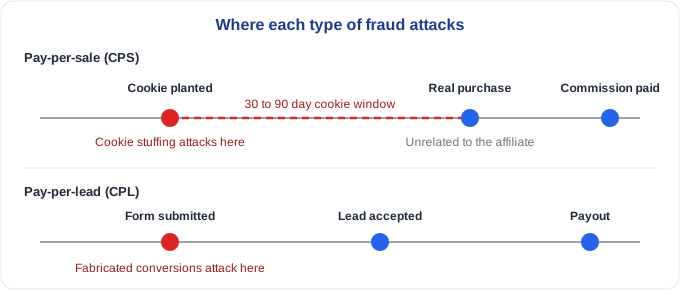
Look at the top lane of the diagram. Everything cookie stuffing does happens at the first dot, when the cookie is planted, and it only pays off at the last dots, when an unrelated purchase lands inside the window. Nothing the fraudster does creates a sale. The scheme just waits for one.
Why cookie stuffing barely touches a pay-per-lead program
Now look at the bottom lane. In a pay-per-lead program, the conversion is the form submission or the phone call. It happens right away, in a single session, and it is recorded at that moment. There is no long gap for a stray cookie to bridge, and no independent purchase that a stuffed cookie can claim credit for later. A cookie cannot fill in a form. It cannot make a phone ring.
That is not the same as saying lead-gen is safe. It means the attack has moved. When the payout is triggered by a lead, the fraud that pays is the fabrication of the lead itself, and that is what a lead-gen advertiser needs to watch.
What actually threatens a pay-per-lead program
The patterns are more mundane than cookie stuffing, and they are visible in the conversion data if you look for them:
- Duplicate and near-duplicate submissions. The same person, or the same script, submitting the same lead more than once, sometimes with small variations meant to slip past an exact-match check.
- Bot-speed conversions. A form completed faster than a person could read the fields and type the answers.
- Shared IP addresses. Many "different" people who all trace back to one connection.
- Throwaway email addresses. Addresses created for the submission and abandoned, or aliases that all land in one inbox.
- Mechanical timing. Leads that arrive at suspiciously even intervals, the rhythm of a script rather than of people.
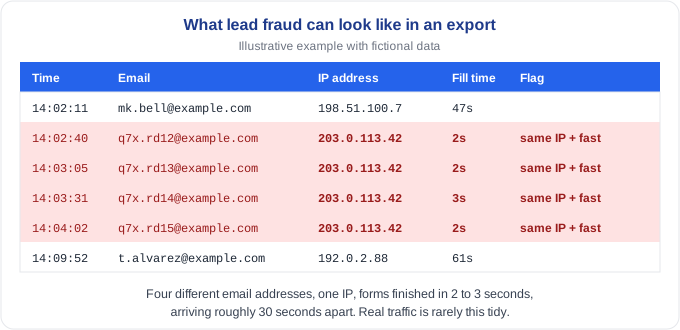
The example above is fictional, but it shows why these signals work best together. Any one of the four highlighted leads might pass a casual glance. The email addresses look different and the names are not identical. Side by side, though, they share an IP address, each was filled in within two or three seconds, and they arrived roughly half a minute apart. None of that has anything to do with cookies. It is all about the moment of conversion, and it only becomes obvious when someone looks at the export as a whole rather than at one lead at a time.
Matching the fraud to the payout model
Different payout models create different incentives, so they attract different attacks.
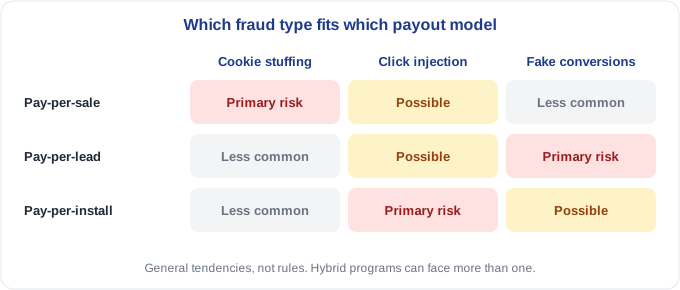
Pay-per-sale programs are most exposed to attribution fraud like cookie stuffing, because the payout depends on which affiliate gets credit for a purchase. Pay-per-install programs are most exposed to click injection, where malware fires a click just before an install completes to steal the credit. Pay-per-lead programs are most exposed to fabricated conversions, because the thing being paid for is cheap to manufacture: a form submission costs a fraudster very little.
Read the matrix as tendencies rather than rules. A pay-per-lead program can still see the occasional attribution problem, and a sales program can still see fabricated orders. But if your effort is going into the column that is not your primary risk, you are defending the wrong door.
What about hybrid programs
Many programs blend the models: a base payout per lead, plus a bonus if the lead later becomes a policy, a funded loan or a completed sale. In that structure both families of fraud matter. The base payout is exposed to fabricated leads. The bonus tier can be exposed to the same attribution games as a pure sales program, particularly if it relies on a cookie or a referral window to tie the later sale back to the affiliate. Treating a hybrid program with only one checklist, borrowed from whichever model feels more familiar, leaves half of it uncovered.
Three questions to find out which problem you have
If you are not sure which side of this you are on, three questions usually settle it.
- What triggers the payout? If it is a purchase that can happen days after a click, attribution fraud is on the table. If it is a form or a call, focus on the conversion.
- Is there a delay between click and conversion? A long cookie window is what makes stuffing worthwhile. No window, no stuffing.
- When you look at your export, do "different" leads share details? Shared IP addresses, near-identical emails and unnaturally fast completion times are the fingerprints of fabricated conversions.
The third question is the one most lead-gen programs never ask, because the total row count looks fine and every individual lead looks plausible. It takes looking at the pattern across the file, and across your history, to see it.
This is the gap TrafficDefenseIQ was built for: scoring the conversion itself, with checks for duplicates, bot-speed completion, shared IPs and email patterns, rather than auditing attribution windows. If you would like to see it on your own data, send us a recent lead export and we will run it through and send back what it flags, at no cost.
Frequently asked questions
Is cookie stuffing illegal? It violates the terms of virtually every affiliate program, and when it involves deliberate deception to collect money, it can cross into fraud under the law. In practice, most programs deal with it by terminating the affiliate and reversing the commissions rather than pursuing a legal case.
How is cookie stuffing detected? Usually through attribution and traffic patterns: a high number of cookies dropped compared with real engagement on the referring page, buyers who show no browsing history on your site before purchasing, or referral traffic from pages that have no logical connection to your product. It is a different detection problem from lead fraud, because it is about the path to a sale rather than the conversion record.
What other types of ad fraud should advertisers know about? Click fraud, which is fake clicks meant to drain budgets or inflate publisher earnings. Click injection, where malware steals attribution just before an app install. And typosquatting, where a look-alike domain intercepts people looking for your brand. Each one attacks a different point in the funnel, the same way cookie stuffing and lead fabrication do.
Can cookie stuffing affect a pay-per-lead program at all? Rarely, and mostly in hybrid programs that add a sale-based bonus to a base lead payout. In that case the bonus can be exposed to attribution manipulation even though the base payout is not.
Whichever payout model you run, the defense has to match the way you are actually being attacked.