October 5, 2026
Home Insurance Lead Fraud: Spotting Fake Quote Requests
The quote request that never turns into a policy
Home insurance lead generation runs on a simple exchange. A shopper asks for a quote, an advertiser pays for the request, and an agent follows up. Plenty of requests never become policies, and that is normal. People compare prices, change their minds or buy elsewhere.
That ordinary drop-off creates a problem. A fabricated request that never converts looks, in a report, exactly like a real one that did not pan out. Both show up as a quote that did not become a policy. A program can carry a meaningful amount of invented volume without anyone noticing, because the number that would reveal it, the share of leads that never converted, already looks high for innocent reasons.
Why this vertical is easy to fake
A few features of a home insurance form make it an easy target.
- The fields are guessable. An address, a rough home value, the year the house was built, the age of the roof and a few yes or no questions. None of it needs inside knowledge to make up.
- Verification is light. Most intake flows do not confirm that the person lives at the address before the lead is counted and paid for.
- Many sources feed the same buyers. Comparison sites, publishers and sub-affiliates all send quote requests, so there are many entry points and a lot of distance between the buyer and whoever generated the traffic.
- Each lead is worth enough to bother. The payout is meaningful, and generating a form submission costs almost nothing.
None of this means most leads are fake. It means the checks have to be deliberate, because the form itself will not catch much.
Separate "did not convert" from "was never real"
The most useful distinction in this vertical is between a real shopper who did not buy and a request nobody actually made.
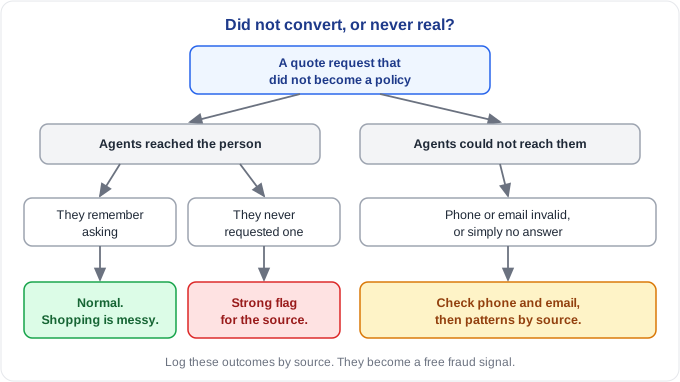
Follow the flow above. If your agents reach the person and they remember asking for a quote, the lead was real, whatever happened next. If they reach the person and the person says they never requested anything, that is the clearest evidence you will get, and it points at the source rather than at one lead. If nobody can be reached, the question becomes whether the phone and email were ever plausible, and whether the same pattern shows up across that source.
This only works if the outcome is recorded. Ask agents to log "never requested" and "could not reach" as separate reasons, not just "no sale". That small habit turns normal follow-up into a running fraud signal by source, at no extra cost.
Check that the fields agree with each other
A guessed or random set of answers tends to contradict itself, because whoever filled in the form was not looking at a real house.
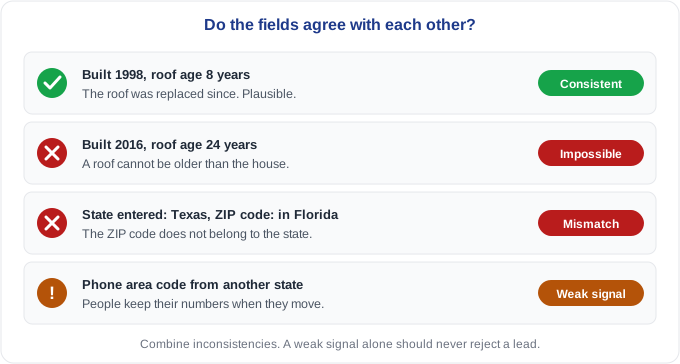
Some contradictions are close to impossible. A roof cannot be older than the house it sits on, so a home built in 2016 with a 24-year-old roof does not hold together. A ZIP code that belongs to a different state from the one entered is another. Both can be checked in a spreadsheet in seconds.
Others are only hints. People keep their phone numbers when they move, so an area code from another state is weak evidence. The same is true of an IP address that geolocates somewhere unexpected, since people travel and use mobile networks and VPNs. Treat those as small points in a larger picture, never as a reason to reject a lead alone.
Confirming that an address exists and is a residential property is a different job and usually needs a property data service. It is a worthwhile layer if your volume justifies it, but it goes beyond what a scoring pass over an export can tell you.
Look for round numbers and pile-ups
People estimating a home value tend to give a figure that feels roughly right, and a real group of homeowners produces a wide, uneven spread. A batch produced by a script, or by one person filling in forms quickly, often does not.
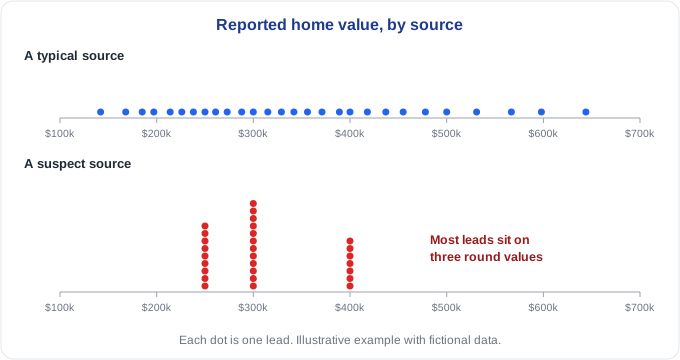
In the example, the typical source has a messy spread with an occasional round number, which is what real estimates look like. The suspect source piles up on three round values. A few round numbers are normal, because people do round. A source where much of its volume sits on the same few figures is worth a closer look, especially if its other fields look equally uniform.
The same idea applies elsewhere. Identical roof ages, identical square footage, or the same answer to every yes or no question across dozens of leads from one source all suggest the answers were chosen rather than reported.
Duplicates: shopping versus stuffing
Duplicates need careful handling in insurance, because real shoppers often request quotes from several comparison sites on the same afternoon. The same person arriving through three sources is common and is not fraud, although it matters if you are paying for exclusivity.
The pattern to worry about looks different: many leads at one address under different names with identical details, one name attached to a long list of addresses, or a lead that keeps reappearing through the same affiliate with small changes. Those suggest a source recycling data, not a household comparing prices.
Real, but low intent
Some low-quality volume is not fabricated at all. Traffic driven by rewards or heavy incentives can produce real people who filled in a form to get something else and have no interest in insurance. Their emails work and they may even answer the phone, but they were never going to buy.
It is worth separating that from invented leads, because the response is different. Fabrication calls for holding payments and challenging the source. Low intent calls for a conversation about traffic quality, or about price. The contact-outcome log helps tell them apart: low-intent leads can be reached and may remember little, while invented ones cannot be reached or never asked.
Demand spikes are not always good news
Home insurance demand is seasonal and event-driven. Renewal periods, rate increases, storm seasons and the home-buying cycle all produce genuine surges. A surge from one affiliate does not mean something is wrong, and it does not mean something is right either.
The question is whether one source is rising faster than its peers, and whether quality signals such as contact rate hold up as volume grows. Compare each affiliate with others running the same offer over the same weeks, rather than only with last month.
A short checklist for your next export
- Check that related fields agree, such as roof age against year built and ZIP code against state.
- Count the most common home values and other answers per affiliate, and look for pile-ups on round figures.
- Normalize email addresses and look for repeats and sequences.
- Look at how long forms took to complete and whether leads arrive at suspiciously even intervals.
- Group leads by IP address and look for many different people behind one.
- Compare each affiliate's contact rate and "never requested" rate with the rest.
Any one of these can have an innocent explanation. Several on the same source is a pattern.
What to do when you find one
Hold the payout on the flagged leads. Phone a small sample to see whether the people recognize the request. Ask the affiliate about the traffic source, and write down what you find. If your team calls or texts leads, a request nobody actually made also raises a consent question, which is worth raising with counsel.
That is a lot of cross-checking to do by hand on a large export. If you would like to see what your own traffic looks like, send us a recent lead export and we will run every lead through our checks, covering duplicates, shared IP addresses, form completion speed and email patterns, and email you a report showing which ones look suspicious and why, at no cost. A flag means a lead deserves a closer look, and the decision stays with you.
Frequently asked questions
Is a quote request that never converts a sign of fraud? Not by itself. Many real shoppers never buy. The useful question is whether the person could be reached and remembers asking, which separates a real shopper from a request nobody made.
Should I reject leads with the same address submitted more than once? Not automatically. Real people request quotes through several sites. Look for the same address with different names, or the same lead returning through one source with small changes.
Can I verify that the address is real? Property data services can confirm that an address exists and what kind of property it is. That is a separate layer from scoring an export, and worth adding once your volume justifies it.
How do I tell fake leads from low-quality real ones? Reach a sample. Invented leads usually cannot be reached or say they never asked. Low-intent leads can be reached but were never serious. The two call for different responses.
A quote request is only worth paying for if someone actually made it.