October 9, 2026
Affiliate Agreement Template: Clauses for Lead Quality
Why a standard template falls short for lead gen
Most affiliate agreement templates cover commission rates, cookie windows, branding rules and termination. That is enough for a program that pays on sales. A pay-per-lead program needs more, because the thing being paid for is harder to define. What counts as a valid lead? What happens to duplicates? How long can the advertiser review before paying? How must a rejection be explained?
If the agreement does not answer those questions, every scrub turns into an argument, and the argument is settled by whoever has more leverage. The clauses below are meant to sit alongside your normal commission and branding terms and settle those questions before any traffic arrives.
A note before the wording: these are sample clauses to adapt, not legal advice. The right language depends on your jurisdiction, your vertical and your other contracts, so have a lawyer review the final agreement.
The eight clauses that matter
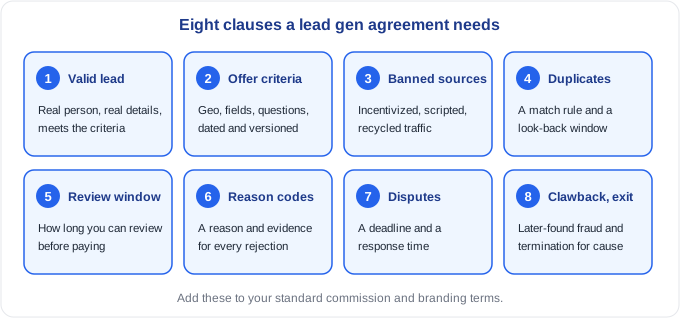
1. What a valid lead is
Everything else depends on this definition, so write it plainly.
A "Valid Lead" is a submission that (a) was entered by a real person who requested the advertised offer, (b) includes accurate contact details, (c) meets the Offer Criteria in Schedule A, and (d) was generated from an Approved Traffic Source.
Each part does a job. Part (a) rules out scripts and invented people, part (b) rules out junk details, part (c) ties the lead to written criteria, and part (d) ties it to a source you have agreed to.
2. Offer criteria
Keep the criteria in a schedule you can update, and date each version. Typical entries are the countries or states you accept, required fields, qualifying questions and any age or eligibility rule. A schedule you can change is easier to maintain than clauses buried in the body of the contract, and a dated version shows which rules applied when a lead was delivered.
3. Prohibited sources and methods
Affiliate shall not generate leads through incentivized traffic, automated or scripted submissions, purchased or recycled data, misleading advertising, or any source not listed as an Approved Traffic Source without Advertiser's prior written approval.
This is where incentivized traffic and recycled data get named. If they are not named, an affiliate can argue they were never forbidden. The affiliate fraud detection guide describes what these patterns look like in an export.
4. Duplicates
A lead is a "Duplicate" if the same email address or phone number was submitted for the same Offer within [X] days, or already exists as an active customer or lead in Advertiser's system. Duplicates are not payable.
Two details matter here. First, say how matching works, including whether variations of the same email address count as one. Gmail ignores dots and plus tags, so jane.doe@gmail.com and janedoe@gmail.com reach the same inbox. Second, say how the advertiser will report duplicates, because the affiliate cannot see the advertiser's database.
5. Review window and payout hold
Advertiser may review delivered leads for [X] days before payment. Leads not rejected within this period are payable, except where fraud is discovered afterwards.
There is no standard length. A longer window gives the advertiser time to check but delays the affiliate's cash, so the number should reflect how quickly you can realistically review and what your affiliates will accept. What matters is that the window is written down and that both sides know when it ends.
6. Reason codes and evidence
Each rejected lead will be reported with a reason code and the data used to apply it. Advertiser will provide the list of rejected leads within [X] business days of the end of the review period.
This clause does the most to prevent disputes. A rejection with a reason and evidence can be checked by both sides. A rejection without them is a claim that cannot be tested.
7. Disputes
Affiliate may dispute a rejection within [X] days of receiving the report. Advertiser will respond in writing within [X] business days.
Give the process a deadline on each side. A dispute process with no timing is not much of a process.
8. Clawback and termination
If Advertiser discovers after payment that a lead was not a Valid Lead, Advertiser may reverse the payment for that lead. Advertiser may terminate this agreement for cause if Affiliate materially breaches the traffic source or lead quality terms.
Be precise about which breaches justify which action. Reversing payment for a handful of leads is a very different step from ending the relationship.
Specific beats vague
The difference between a clause that works and one that causes arguments is usually specificity.
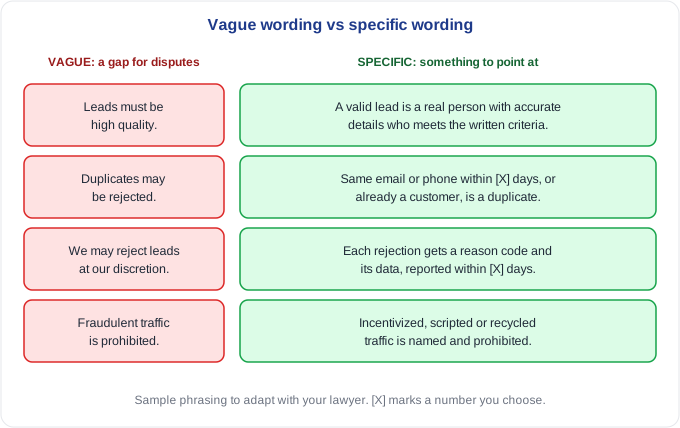
"Leads must be high quality" gives you nothing to point at when a lead is disputed. "A Valid Lead is a real person with accurate details who meets Schedule A" does. The same goes for duplicates, for the discretion to reject, and for prohibited traffic. Each vague version leaves a gap, and the gap is where disputes start.
Where the clauses apply
The clauses cover different moments in a lead's life.
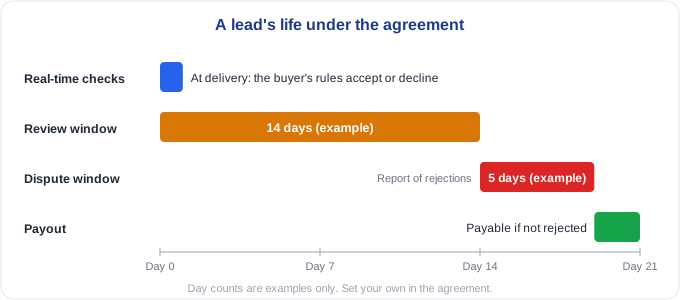
Real-time checks apply at delivery, the review window covers the period before payment, the dispute window follows the report of rejections, and payout comes after that. The day counts in the diagram are examples only, so set your own. What counts is that each stage has an owner, a length and an outcome.
Add these with your lawyer
Some topics are too dependent on your situation to give sample wording, and they should go through counsel:
- A representation about how consumer consent was obtained, particularly if you call or text leads.
- Rules for handling and deleting personal data.
- Limits of liability and indemnity.
- Governing law and where disputes are heard.
- Anything specific to a regulated vertical such as insurance, lending or healthcare.
Putting the clauses to work
Clauses only help if you can apply them with evidence. An export analysis can show which leads are duplicates, which carry disposable or machine-made emails, which share an IP address and which arrived in a burst, so a rejection can point to a pattern rather than a hunch.
If you would like to see what your own leads look like, send us a recent lead export and we will run every lead through our checks and email you a report showing which ones look suspicious and why, at no cost. A flag means a lead deserves a closer look, and the decision stays with you.
Frequently asked questions
Do I need a written affiliate agreement for a pay-per-lead program? Putting the terms in writing is strongly advisable, because it gives both sides something to refer to when a lead is disputed. Have a lawyer review it.
How long should the review window be? There is no standard. It depends on how quickly you can review leads and how long your affiliates can wait for payment. Choose a number you can keep, and write it down.
Can I reject leads after I have paid for them? Only if the agreement allows it. A clawback clause that names the circumstances, such as a lead that was not a Valid Lead, gives you that right in writing.
What should a reason code look like? A short label tied to a rule in your criteria, such as duplicate, invalid contact details, outside the target region, or a prohibited source, plus the data that triggered it.
Is this template legally binding? No. These are sample clauses to adapt. They only become part of a binding agreement when they are written into a contract that a lawyer has reviewed for your situation.
A lead quality clause is only as good as the evidence you can bring to it.