October 8, 2026
Lead Scrubbing and Scrub Rates in Affiliate Marketing
What lead scrubbing means
In lead generation, a lead is scrubbed when the advertiser decides not to buy it. An affiliate or network delivers a batch of leads, the advertiser applies its own checks, and some leads come back rejected. Those rejections are the scrub. The share of delivered leads that gets rejected is the scrub rate.
The arithmetic is simple: leads generated, minus leads purchased, divided by leads generated. If an affiliate sends 100 leads and the advertiser buys 80, then 20 were scrubbed and the scrub rate is 20%.
The word is also used in a second sense, cleaning a contact list before calling it, for example against a do-not-call list. This article is about the first sense, the one affiliates and advertisers actually argue about.
Why leads get scrubbed
Most scrubs fall into a few groups.
- Duplicates already in the advertiser's system. A lead who is already a customer, or who was bought last week, cannot be sold again as new. The affiliate usually has no way of knowing this in advance.
- Placeholder and junk entries. Obvious fakes such as
asdf@asdf.com, or addresses that cannot receive mail. The disposable email checklist covers the common patterns. - Falsified or inaccurate details. Invented names, wrong phone numbers, or details that contradict each other.
- Repeats from one IP address. Some advertisers match duplicate submissions by IP address and reject the extras.
- Suspected fraud or terms violations. Scripted submissions, or traffic from a source the agreement forbids.
- Missing the buyer's criteria. Wrong state, outside the service area, or a failed qualifying question. These are often rejected in real time, before the lead is accepted at all.
The criteria differ by contract, so a scrub rate means very little until you know the rules behind it.
Three kinds of scrub
Not every scrub is the same kind of decision.
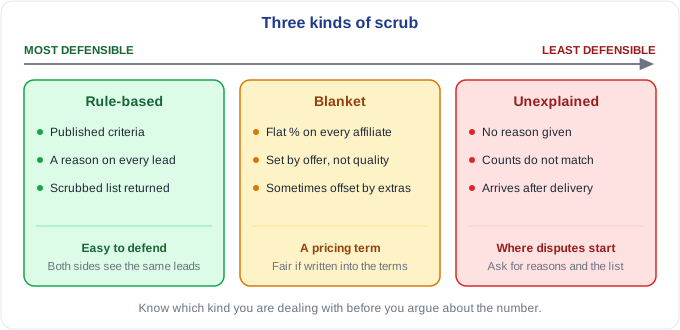
A rule-based scrub applies published criteria, attaches a reason to each rejected lead, and returns the list. It is the easiest to defend, because both sides can look at the same leads and the same rule.
A blanket scrub takes a flat percentage off every affiliate on an offer, whatever the quality of their traffic. It is a pricing decision rather than a quality judgment, and some programs offset it by delivering extra leads to cover the expected rejections. It can be perfectly fair when it is written into the terms and applied evenly.
An unexplained scrub rejects leads without a reason, or produces numbers that do not match the affiliate's own stats. This is where most disputes start.
It helps to know which kind you are dealing with before you argue about the number.
Same rate, different story
A scrub rate is one number, and it hides the cause.
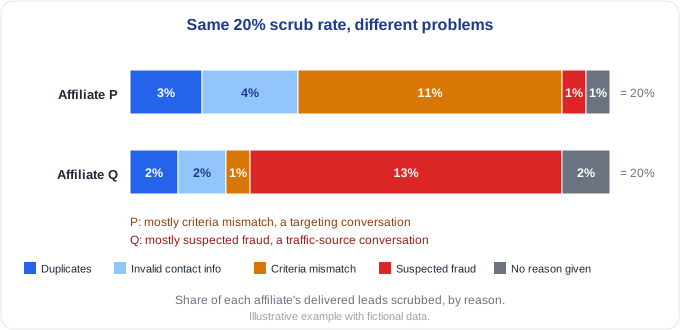
In the example, both affiliates are scrubbed at 20%. Affiliate P is mostly losing leads that miss the buyer's criteria, which suggests a targeting problem that can be fixed with a conversation. Affiliate Q is mostly losing leads to suspected fraud, which points at the traffic source. The fix is different, and so is the tone of the conversation.
Three habits make a scrub rate useful:
- Always ask for the breakdown by reason, not just the total.
- Compare affiliates running the same offer over the same weeks, rather than judging one against a fixed target.
- Watch the trend. A rate that jumps from one week to the next is a better signal than a rate that is merely high.
A high scrub rate is not proof of fraud. It can come from duplicates against the advertiser's own database, from a mismatch with the buyer's criteria, or from a targeting error. A low one is not proof of quality either.
Where leads drop out
Scrubs happen at two different points, and mixing them up causes confusion.
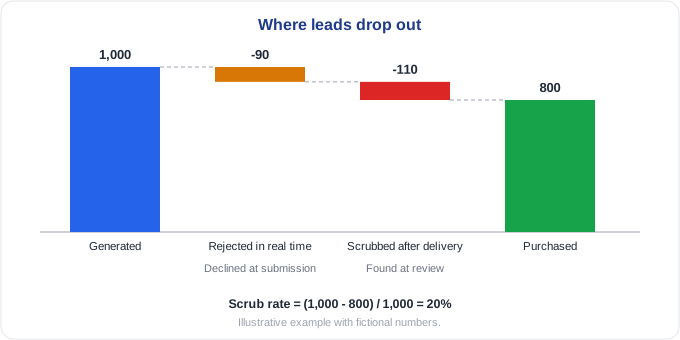
Real-time rejections happen at submission. The buyer's rules decline the lead immediately, and the affiliate can often see it. Post-delivery scrubs happen later, when the advertiser reviews what was sent. They can arrive days afterwards, and they are where disagreements about what counts usually begin.
Both sides should reconcile their numbers. It is common for an advertiser's count and an affiliate's count to disagree, and sorting out which leads each side thinks were delivered is often the whole dispute.
If you are the advertiser
- Write the criteria into the agreement before any traffic arrives.
- Give every scrubbed lead a reason.
- Return the list of scrubbed leads so the affiliate can check it.
- Apply the same rules to every affiliate on the offer.
- Keep the evidence: the timestamp, the source, and which rule fired.
- Do not scrub after you have paid unless the terms allow it. Check your own agreement, and ask counsel if the terms are unclear.
A scrub backed by a reason and evidence ends the conversation. A scrub without them starts a dispute, and it can cost you a good partner.
If you are the affiliate
- Ask for the scrubbed leads, with reasons.
- Compare them against your own records, including postback logs and your tracking stats.
- Run your own checks before delivery: remove duplicates within your batch, drop obvious junk emails, and make sure phone and email are present.
- Look at which sources produce the scrubs, not at the average across everything.
- Treat a flat scrub applied to everyone as a pricing term to negotiate, not as a verdict on your traffic.
Using analysis on your own export
Scrubbing decisions are better when they rest on evidence. An export analysis can show which leads are duplicates, which carry disposable or machine-made emails, which sit behind the same IP address and which arrived in a burst, so a rejection can point to a pattern instead of a hunch. The affiliate fraud detection guide walks through the three levels to check, and the conversion rate article covers one of the most common warning signs.
If you would like to see what your own leads look like, send us a recent lead export and we will run every lead through our checks and email you a report showing which ones look suspicious and why, at no cost. A flag means a lead deserves a closer look, and the decision stays with you.
Frequently asked questions
What is lead scrubbing? It is the practice of an advertiser or network rejecting delivered leads that fail its checks, so they are not paid for. Leads can be rejected in real time or reviewed after delivery.
How do you calculate a scrub rate? Subtract the leads purchased from the leads generated, then divide by the leads generated. Sending 100 leads and having 80 bought gives a scrub rate of 20%.
What is a normal scrub rate? There is no reliable public benchmark. Rates vary by vertical, offer and contract, and the figures that circulate are mostly anecdotes. The most useful comparison is between your own affiliates on the same offer.
Is a high scrub rate proof of fraud? No. Duplicates against the advertiser's existing database, criteria mismatches and targeting errors all raise it. The breakdown by reason tells you which one you are looking at.
Can an advertiser scrub leads after paying for them? It depends on the agreement. Terms that allow post-payment scrubs should say so explicitly. Check the contract, and ask counsel if it is unclear.
A scrub rate only means something when it comes with its reasons.