October 13, 2026
Earnings Per Click (EPC) in Lead Gen: When It Hides Fraud
What earnings per click means
Earnings per click, or EPC, is a simple ratio: the total earnings from a source divided by the number of clicks it sent. Some networks report it per 100 clicks, which just moves the decimal point.
Affiliates use EPC to compare offers, because it shows how much a click on one offer is worth against another. Advertisers and affiliate managers use it to compare partners, and to decide who gets more volume, a higher payout or a bigger cap.
It is a useful number. The problem is what it quietly rewards.
EPC in a lead gen program
In a program that pays per lead, EPC comes from two ingredients: how often a click turns into a lead, and what each lead pays.
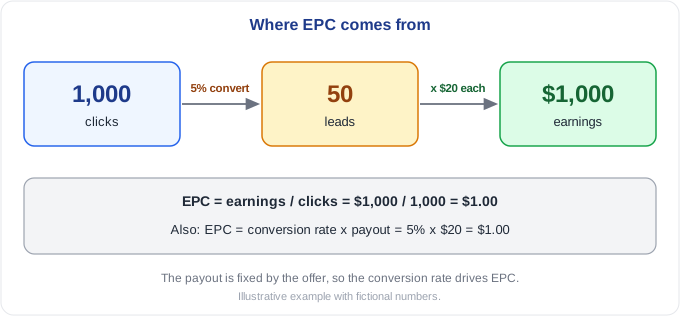
With 1,000 clicks, a 5% conversion rate and a 20 dollar payout, a partner earns 1,000 dollars, so the EPC is 1 dollar. The same figure falls out of multiplying the conversion rate by the payout: 5% of 20 dollars is 1 dollar per click.
That second form is worth remembering. Since the payout is fixed by the offer, the conversion rate does almost all the work. Anything that raises the conversion rate raises the EPC, whether or not the leads are any good.
The trap: EPC rewards whatever converts
EPC counts leads at the moment they are submitted. It has no idea whether the person behind a lead wanted anything.
A bot that fills in forms converts very well. Reward-driven traffic converts very well, because people are being paid to complete the offer, which is what the incentivized traffic guide is about. Recycled data and repeat submissions convert well too. All of them push the conversion rate up, and the EPC goes with it.
That creates an uncomfortable result. The partner at the top of your EPC ranking might be your best performer. They might equally be the one whose leads are least real. If you reward the ranking with more volume or a higher payout, you pay the most to the traffic you should be checking first.
Gross EPC and net EPC
The fix is to measure EPC twice: once on every lead submitted, and once on the leads that actually survive review.
Gross EPC counts every lead. Net EPC counts only the leads that remain payable after you remove rejections, such as duplicates, invalid contact details and flagged leads. The lead scrubbing guide explains how those rejections are decided and kept fair.
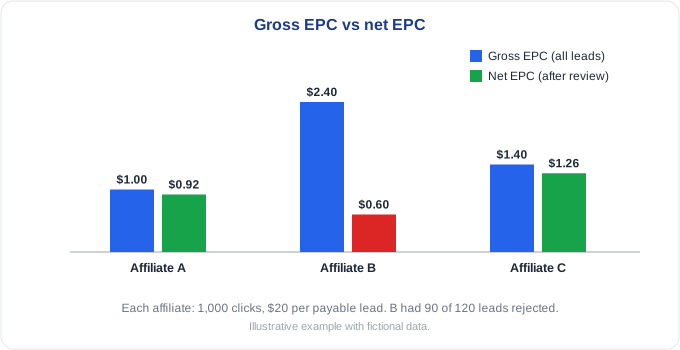
In the example, three affiliates each send 1,000 clicks on a 20 dollar offer. On gross EPC, Affiliate B looks like the star, at 2.40 dollars a click. After review, most of B's leads are rejected, and its net EPC falls to 60 cents, the lowest of the three. Affiliate C, which looked second on gross, is first on net.
If you had ranked on gross EPC, you would have rewarded the wrong partner.
Other ways EPC can mislead
Fake leads are not the only way EPC goes wrong. Two more are worth knowing.
The click count can be wrong too. EPC divides by clicks, so anything that inflates or deflates the click count changes the answer. Bot clicks make EPC look lower than it should. Duplicate or filtered clicks do the same thing in reverse. If two reports disagree on clicks, you will get two different EPCs for the same partner, so agree on which count is the source of truth.
EPC only compares like with like. A partner on a 40 dollar offer will show a higher EPC than one on a 10 dollar offer even if their traffic converts the same way. Compare EPC across partners on the same offer and payout, and across offers only after you have looked at conversion rate and outcomes.
Read EPC alongside other signals
EPC is most useful as one input. It tells you what a partner's traffic is earning, and the other signals tell you whether the earnings are real.
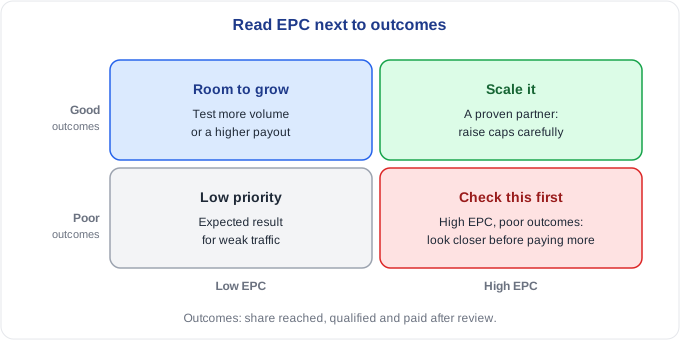
Look at EPC next to three things:
- Conversion rate against peers. An affiliate whose rate sits far above others on the same offer deserves a closer look. The conversion rate guide explains why.
- What happens after the lead. The share reached, the share that remember asking and the share that qualify.
- Patterns in the export. Duplicates, disposable emails, bursts, unusually fast form completion and shared IP addresses, which the affiliate fraud detection guide covers.
High EPC with good outcomes is a partner to scale. High EPC with poor outcomes is the one to check before anything else.
Working out net EPC from your own data
You need three numbers per affiliate and offer over the same period: the clicks, the leads delivered and the leads rejected. Subtract the rejected leads from the delivered ones to get the payable leads, multiply by the payout per lead, and divide by the clicks. That is the net EPC.
The tracker usually gives you clicks and delivered leads. The rejected count comes from your own review, which is why recording a reason for every rejection is worth the effort. It lets you rebuild the number later and show how you got it.
What to do with this
- Report net EPC next to gross EPC for every affiliate and offer.
- Compare partners on the same offer and the same weeks, not against a fixed number.
- Hold increases in caps or payouts until net EPC and downstream outcomes agree.
- Watch the trend. A sudden jump in EPC is a reason to look, not to celebrate.
- Keep records. If you reduce a payout or a cap, be able to show why.
If you are the affiliate
EPC is often how advertisers judge you, so the number they see is probably the one that decides your payout and caps. A high EPC built on leads that later get rejected will not last. Net EPC, the earnings that actually get paid, is the figure to optimize.
Checking your own numbers
To see how much of your EPC survives review, a recent export is the quickest test. Send us a recent lead export and we will run every lead through our checks and email you a report showing which ones look suspicious and why, at no cost. A flag means a lead deserves a closer look, and the decision stays with you.
Frequently asked questions
What is earnings per click? It is total earnings divided by the number of clicks. Some networks report it per 100 clicks.
How do you calculate EPC in lead gen? Multiply the number of leads by the payout per lead, then divide by clicks. It is also the conversion rate multiplied by the payout.
Is a high EPC always good? No. A high EPC can come from fake, scripted or reward-driven leads that convert well but are later rejected. Check it against outcomes after the lead.
What is net EPC? EPC calculated only on leads that remain payable after review, with rejected leads removed. It is a better measure of what a partner's traffic really earns.
What is the difference between EPC and CPC? CPC is what you pay per click. EPC is what a click earns for the partner. They measure opposite sides of the same traffic.
An EPC is only as trustworthy as the leads behind it.