October 10, 2026
Lead Generation Affiliate Marketing: An Advertiser's Guide
What lead generation affiliate marketing is
In lead generation affiliate marketing, an advertiser pays partners for leads instead of sales. An affiliate sends traffic, a person fills in a form, and the advertiser pays when that submission meets agreed terms. The payment might be for any valid lead, for a lead that meets extra criteria, or for something further down the funnel such as a booked appointment.
Most guides on this topic are written for the affiliate, and they explain how to earn from leads. This guide is written for the advertiser, the side that sets the terms, pays the bills and lives with the quality of what arrives.
Who does what
A lead gen program has four parties, and each handoff between them is a place where a lead can go wrong.
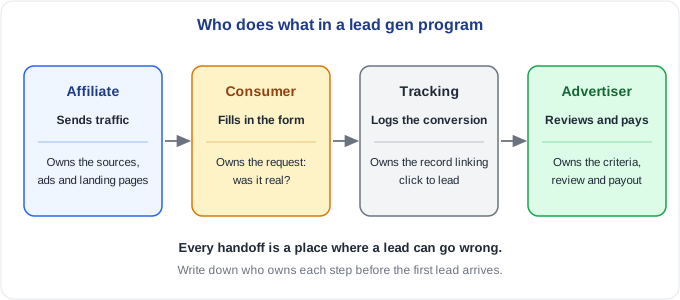
The affiliate owns the traffic: the sources, the ads and often the landing page. The consumer owns the request, and whether a real person actually made one is the whole question behind lead quality. The tracking platform owns the record that connects a click to a lead. The advertiser owns the criteria, the review and the payout.
If any of those jobs is left vague, disagreements follow. The agreement template guide covers how to write the advertiser's side down.
Choose what you pay for
The most important decision in the program is the event you pay for. The further it sits from the first form submission, the less exposed you are to fake leads and the longer your affiliates wait to be paid.
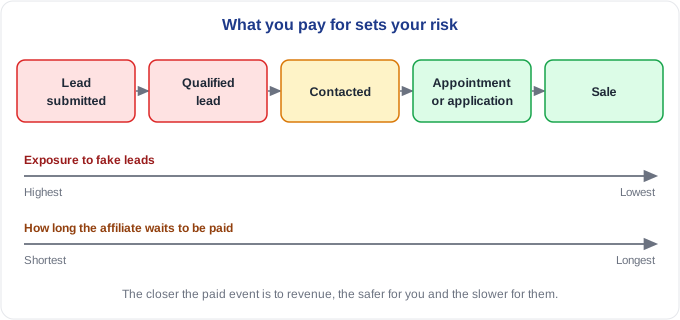
- Pay per lead pays for any valid submission. It is the easiest model for affiliates to sell and the most exposed to junk, because a form fill costs almost nothing to produce.
- Pay per qualified lead pays only when the lead meets written criteria, such as region, eligibility or a qualifying answer.
- Pay per contact, appointment or application pays once something real has happened after the form. It filters out most invented leads, but it asks the affiliate to wait and to trust your follow-up.
- Pay per sale is closest to revenue. Fake leads matter far less, but few affiliates will accept the wait and the risk unless the payout is large.
There is no right answer, only a trade. Many programs start with a qualified-lead model and add a bonus for downstream outcomes, which rewards partners whose leads actually convert.
A worked example of setting a payout
The right payout comes from what a lead is worth to you. Here is a made-up example to show the arithmetic, not a benchmark.
Suppose one in ten qualified leads becomes a customer, and each customer is worth 500 dollars in margin. The expected value of a qualified lead is 50 dollars. You then decide how much of that to share with the affiliate. Paying 30 dollars leaves 20 dollars to cover your own follow-up costs and some fake or low-intent leads. Paying 45 dollars leaves almost nothing, so a handful of bad leads turns the program unprofitable.
The same logic shows why quality matters so much. If a fifth of what you pay for is not real, the effective cost of every real lead rises by a quarter, because you are covering the cost of the fakes. Your own numbers will differ, but the exercise is worth doing before you publish a payout.
Set the program up before the traffic starts
Several decisions are cheaper to make before the first lead arrives.
- Define a valid lead in writing. A real person who requested the offer, with accurate details, who meets your criteria and came from an approved source.
- List the approved traffic sources. Say what is not allowed, including incentivized traffic and purchased data, and require approval for anything new.
- Set up conversion tracking. A server-to-server postback tells the tracker when a lead is accepted. The postback tracking guide explains how it fits with scoring.
- Choose a review window and a payout schedule. Both sides should know when a lead can still be rejected and when payment is due.
- Set caps. A cap per affiliate limits how much a new partner can send before you have seen any outcomes.
- Vet new partners. Ask how they generate leads, look at their landing pages and start small.
Watch quality from the first batch
Fraud rarely announces itself, so build the habit of looking early.
Compare affiliates running the same offer over the same weeks. An affiliate whose conversion rate or flagged share sits far from its peers deserves a closer look, and the conversion rate guide explains why. Look at what happens after the lead: how many were reached, how many remembered asking, how many moved forward. Check each export for duplicates, disposable emails, bursts and shared IP addresses, which the affiliate fraud detection guide covers in three levels.
When you do reject leads, give each one a reason. A rejection with a reason is a conversation, and one without is a dispute. The article on lead scrubbing and scrub rates goes into how to keep scrubs fair.
Scale in stages
A new partner should earn volume rather than receive it.
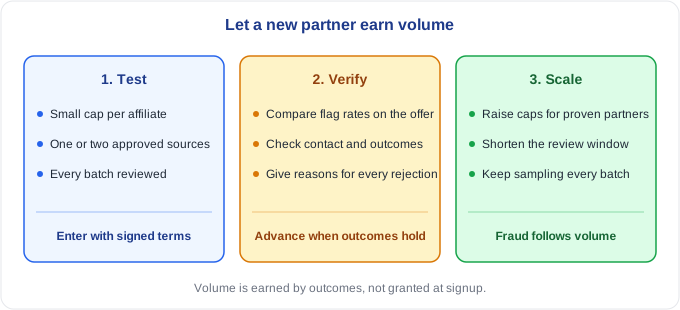
In the test stage, the partner has a small cap, one or two approved sources, and every batch is reviewed. In the verify stage, you compare flagged rates and downstream outcomes with other affiliates on the same offer, and resolve any rejections with reasons. Only then do you scale, raising caps for proven partners and perhaps shortening the review window as a reward. Keep sampling after that, because fraud tends to follow volume.
Mistakes to avoid
- Paying on raw submissions with no written definition of a valid lead.
- Judging an affiliate on conversion rate alone, when a very high rate can be a warning sign.
- Leaving caps off for new partners.
- Rejecting leads without reasons, or after payment without terms that allow it.
- Never telling affiliates what happened to their leads, so the good ones cannot improve and the bad ones cannot be identified.
Checking your own program
If you already run a program, the quickest test is to look at a recent export. Send us a recent lead export and we will run every lead through our checks and email you a report showing which ones look suspicious and why, at no cost. A flag means a lead deserves a closer look, and the decision stays with you.
Frequently asked questions
What is lead generation affiliate marketing? It is a performance model in which an advertiser pays affiliates for leads, such as form submissions or qualified inquiries, instead of for sales.
What is the difference between pay per lead and pay per qualified lead? Pay per lead pays for any valid submission. Pay per qualified lead pays only when the lead also meets written criteria, such as region or eligibility.
How much should I pay per lead? It depends on what a lead is worth to you, which comes from your conversion rate and your revenue per customer. Pay a share of that value, and leave room for the affiliate's costs.
How do I stop fake leads in an affiliate program? Define a valid lead in writing, limit new partners with caps, compare affiliates on the same offer, check exports for duplicates and unusual patterns, and look at what happens to leads after delivery.
Do I need a tracking platform? You need a reliable way to connect each lead to the affiliate and source that sent it. Most programs use a tracking platform with a server-to-server postback for that.
A lead gen program is only as good as the leads it can prove are real.