October 14, 2026
Co-Registration Leads: Quality Risks and Checks
What co-registration leads are
Co-registration, usually shortened to co-reg, is a way of generating leads from people who are already in the middle of signing up for something else. A visitor joins a website, enters a contest, or registers for a service. On the next screen, or alongside the form, they are offered a list of other offers from partner advertisers, each with a checkbox. Tick a box and your details are passed to that advertiser as a lead.
Advertisers like co-reg because it scales. The traffic is already there, the person has already typed their name and email, and the extra step is one click. Affiliates and publishers like it for the same reason, because every visitor who passes through the signup becomes a chance to sell another lead.
The catch is in the description. The person came to do something else. The click that created your lead was a side effect of a different goal.
Where co-reg leads can go wrong
None of these problems is guaranteed, but they come up often enough to be worth checking for.
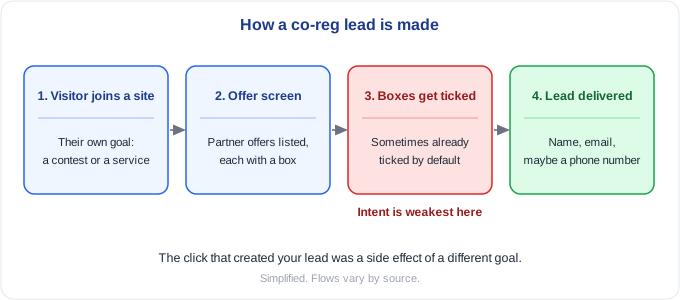
- Low intent. The visitor did not go looking for your product. A checkbox on the way past is a very small commitment, so many co-reg leads do not remember the offer at all.
- Pre-ticked or buried boxes. If offers arrive already selected, or the wording is hard to read, the lead did not really choose. Besides hurting quality, that can create consent problems, which are covered below.
- Shared leads. Many co-reg leads are sold to several advertisers at once. The same person may be contacted by a handful of buyers within minutes, and the first to reach them usually wins.
- Everything accepted. A signup flow that nudges people to accept every offer produces leads that look plentiful and behave poorly.
- Repeats across offers and files. The same people tend to pass through co-reg flows again and again, so duplicates are common, including variations of the same email address, as explained in the email normalization guide.
Consent needs a closer look
Whether a lead can be contacted by phone, text or email depends on the consent the person gave, not just on the fact that a box was ticked. Rules vary by country, by channel and by the kind of product. Wording that names the advertiser and clearly describes how they will be contacted is stronger than wording that bundles many partners together.
Because this is a legal question, treat the points here as things to ask about, and take advice from counsel on what your own consent evidence needs to look like. What you can do without a lawyer is ask for the evidence: what the screen looked like, what the checkbox said, and whether it was ticked by default.
What to ask for and what to look at
Co-reg quality is easier to judge when you ask for specifics up front and then check them against the leads you receive.
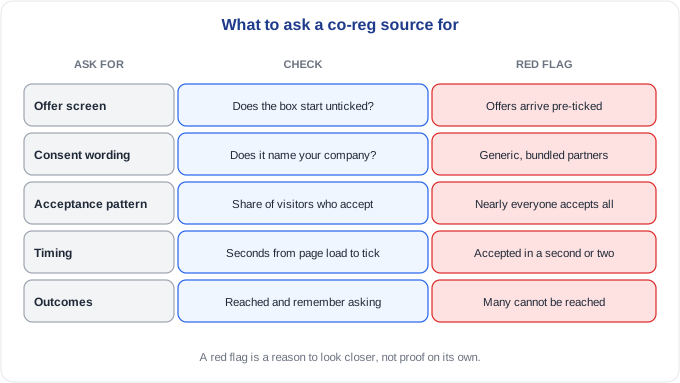
Ask the source to show you the offer screen as a visitor sees it. Check whether the box starts unticked and whether your company is named. Look at the acceptance pattern: if almost every visitor accepts almost every offer, the flow is steering them. Look at the timing between the page loading and the box being ticked, because a lead that arrives in a second or two was probably not read. Then follow what happens after the lead is delivered: whether it can be reached and whether the person remembers asking.
Some of these checks, such as fast acceptance, bursts and repeats, show up directly in your export, and the affiliate fraud detection guide covers how to read them.
The speed problem with shared leads
When a lead is shared, its value decays quickly.
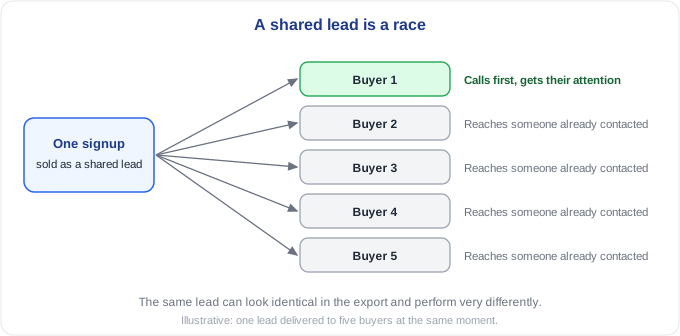
If five buyers receive the same lead at the same moment, only one of them is likely to get the person's full attention. The rest reach someone who has already talked to a salesperson, or who no longer remembers signing up. That matters when you compare sources, because a shared co-reg lead and an exclusive lead can look identical in the export and perform very differently. Find out whether a source is exclusive or shared before you judge its numbers.
Judge it on cost per customer
Co-reg leads are usually cheaper than leads from people who searched for the product, and the lower price is fair, because the intent is lower. The mistake is comparing sources on cost per lead alone. A cheap lead that never reaches a conversation is expensive, and a pricier lead that turns into a customer is not.
Work out what each source costs per qualified lead and per customer, using the same method for every source. The advertiser's guide has a worked example of how a lead's value sets a sensible payout. A source that looks poor on cost per lead and good on cost per customer is worth keeping, and the reverse is a source to question.
How to buy co-reg safely
- Ask to see the offer screen and the consent wording before you start.
- Confirm whether leads are exclusive or shared, and price accordingly.
- Start with a small cap and watch what happens downstream before you scale.
- Use a separate sub ID so co-reg traffic can be reported, capped and paid on its own. The incentivized traffic guide explains why separating sources matters.
- Write the rules into the agreement. The agreement template guide has sample wording for naming prohibited sources and giving reasons for rejections.
- Pay for outcomes where you can, such as a qualified lead or a contact, rather than for every box ticked.
If you run the co-reg flow
Make the choice clear. Offers that start unticked, wording that names the advertiser, and a short, readable description produce leads that advertisers keep buying. A flow that tricks people into accepting might produce more leads this month and fewer buyers next quarter.
Checking your own co-reg leads
If you already buy co-reg, a recent export is the quickest place to see what is going on. Send us a recent lead export and we will run every lead through our checks and email you a report showing which ones look suspicious and why, at no cost. A flag means a lead deserves a closer look, and the decision stays with you.
Frequently asked questions
What are co-registration leads? They are leads created when a person who is signing up for something else ticks a box to be contacted by a partner advertiser.
Are co-reg leads good quality? It varies by source. Intent is often lower than for leads from people who searched for the product themselves, so measure what happens after the lead rather than assuming.
What is the difference between shared and exclusive co-reg leads? A shared lead is sold to more than one advertiser at the same time. An exclusive lead goes to one. Shared leads usually reach buyers who are competing for the same person's attention.
Is a pre-ticked checkbox acceptable? It makes the lead's consent harder to defend and tends to lower quality. Ask your counsel what your own situation requires, and prefer sources whose boxes start unticked.
How can I tell whether co-reg traffic is good? Ask to see the offer screen, check the acceptance pattern and timing, separate the traffic by sub ID, and track contact and qualification rates by source.
Co-reg leads can work, as long as you know how they were made.