October 18, 2026
Affiliate Payout Reconciliation: A Step-by-Step Guide
What payout reconciliation is
Payout reconciliation is the monthly job of agreeing on what you owe each affiliate. Three different records rarely match on the first pass: what the affiliate or tracking platform says was delivered, what your own system actually received, and what ended up accepted or paid.
When they differ, the question is not who is right. It is why they differ, and each reason has a different fix. A lead that never arrived because a tracking call failed is a technical problem. A lead rejected as a duplicate is a data problem. A lead still waiting for an outcome is a timing problem. Treat them all as "discrepancies" and every payout turns into an argument.
Reconciliation done well takes the argument out. It produces a number that both sides can check line by line.
Step 1: Agree on the period and the cutoff
Most disputed totals begin with two people counting different days. Settle the rules before you pull any data.
- Which date counts. The date the lead arrived, the date it was accepted, or the date of the outcome. Pick one and use it for every partner.
- Which time zone. A lead at 11:30 pm in one zone is tomorrow's lead in another.
- When the books close. Leads that arrive after the cutoff belong to the next period, not the last.
Write these down in the agreement. The agreement template guide has sample wording for the review window and for giving a reason with each rejection.
Step 2: Pull the three records
You need the same period from three places.
- The claimed list. What the affiliate or tracking platform reports as delivered.
- The received list. Every lead that reached your system, with its time, source and sub ID.
- The outcome list. What happened next: contacted, qualified, sold, rejected.
Keep each export exactly as it was pulled. Reconciliation is much easier to defend when you can show the raw files as well as your working copy.
Step 3: Match by ID, not by totals
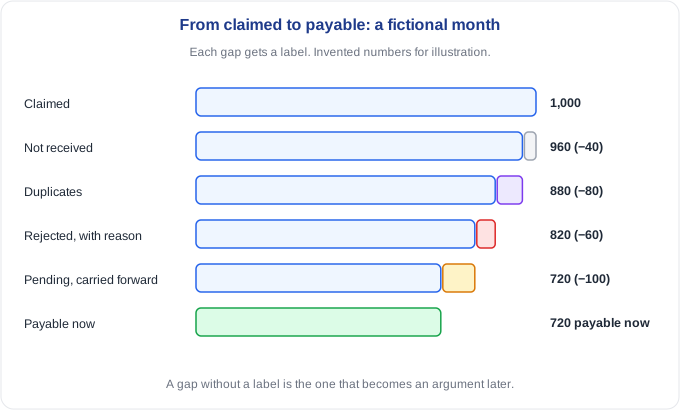
The most common mistake is comparing totals. If the affiliate says 1,000 and you say 960, you know there is a gap of 40 but not which leads are missing, and a gap in one direction can hide a gap in the other.
Match lead by lead instead, using a key that both records share, such as a click ID, a lead ID or a sub ID. Where no shared ID exists, match on a normalized email address, as the email normalization guide explains, so that capital letters and Gmail dots do not break the match.
Every lead then lands in one of four places: in both lists, only in the claimed list, only in your received list, or in both but with a different outcome.
Step 4: Give every gap a label
The figure above is a fictional example. A large claim shrinks in stages, and each stage has its own cause. Your job is to label each one.
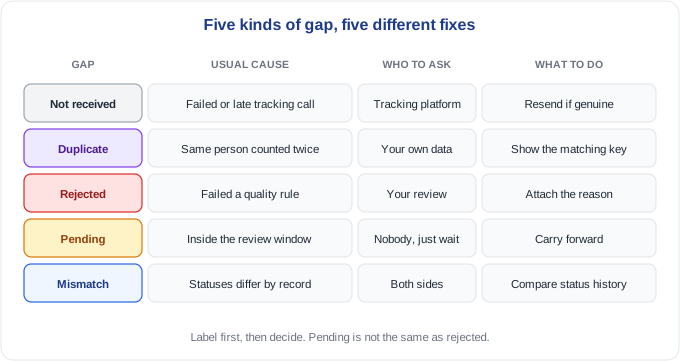
- Not received. Claimed but absent from your records. Often a failed or delayed tracking call. The postback tracking article explains why those happen. Ask the platform for the raw event and resend where it is genuine.
- Duplicate. The same person counted twice. Show the matching key so the affiliate can see why.
- Rejected. Failed your quality rules. Attach the reason, as the lead scrubbing guide recommends, and keep the evidence.
- Pending. Still inside the review window or waiting on an outcome. Carry it forward, do not reject it. The conversion lag article explains why real leads need days.
- Outcome mismatch. Both sides have the lead but disagree on what happened to it. Compare timestamps and the status history.
A discrepancy with no label is the one that causes trouble later. If you cannot say why a lead is excluded, either find out or pay it.
Step 5: Review the flagged sources first
Do not spend equal time on every line. Reconciliation is a good moment to look at the sources whose numbers are unusual, such as a source with an unusually high rejection share or a sudden jump in volume. Our checklist for spotting fake leads lists the checks to run, and the affiliate fraud detection guide explains how to combine them.
A flag means the source deserves a closer look, not a verdict. Sample a few leads, and compare them with a healthy source, before you reject a batch. Rejections should rest on your agreement and your evidence, so if a dispute looks likely, take advice from counsel on what your own contract allows.
Step 6: Send the statement before the payment
Share the reconciliation with the affiliate before you pay, not after.
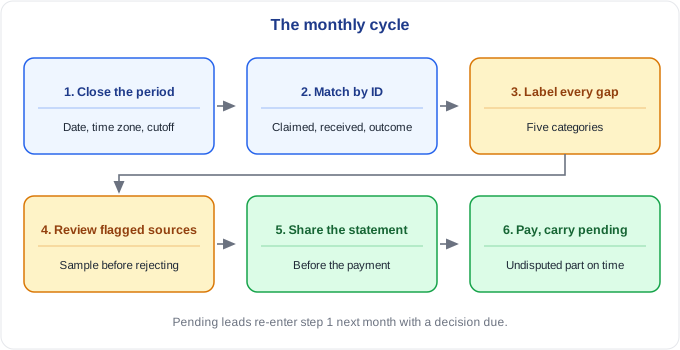
A good statement is short. It shows the claimed total, each category of gap with its count and reason, the number payable now and the number carried forward. When the affiliate can see the arithmetic, most questions answer themselves, and disagreements shrink to specific leads instead of whole months.
Give a short window, such as a few business days, for the affiliate to respond with evidence. Then pay the agreed amount. If a few leads remain in dispute, pay the undisputed part on time and keep working on the rest, so a small disagreement does not delay the entire payout.
Step 7: Carry pending forward and keep the records
Pending leads are the part most programs lose track of. When a lead's review window closes, it should move to payable or rejected with a reason, in the next period's statement. Keep a simple running list so nothing falls out.
Keep the raw exports, your working file and each statement for as long as your agreement and your accounting rules require. If a question comes up months later, that record is what resolves it.
A short checklist
- Fix the rules first: date, time zone and cutoff.
- Pull claimed, received and outcome lists and keep the raw files.
- Match by ID, with normalized email as a fallback.
- Label every gap: not received, duplicate, rejected, pending, mismatch.
- Look at unusual sources first, and sample before rejecting.
- Send the statement before the payment.
- Pay the undisputed amount on time, and carry pending forward.
Before the month closes
The cleaner your leads are when they arrive, the less there is to reconcile. If you want to see which of this period's leads trip our checks, send us a recent lead export and we will run every lead through our checks and email you a report showing which ones look suspicious and why, at no cost. A flag means a lead deserves a closer look, and the decision stays with you.
Frequently asked questions
What is affiliate payout reconciliation? It is the process of comparing what an affiliate reports, what you received and what was accepted, and explaining every difference before you pay.
How often should I reconcile? Most programs do it monthly, in line with their payment cycle. Programs with high volume or weekly payouts may reconcile more often.
Why do my numbers differ from the affiliate's? Common reasons are failed or delayed tracking calls, duplicates, leads rejected for quality reasons, leads still pending, and different cutoffs or time zones. Matching lead by lead shows which one applies.
Should I pay while a dispute is open? Many programs pay the undisputed part on time and keep the disputed leads open. Check what your agreement says, and ask counsel if a dispute is significant.
What should a reconciliation statement include? The claimed total, each category of gap with a count and reason, the amount payable now and the amount carried forward.
Reconciliation works when every lead has a status, and every status has a reason.