October 15, 2026
How to Spot Fake Leads: A 10-Point Checklist
Fake, low-intent or mistaken
Before the checklist, one distinction saves a lot of wasted effort. A bad lead is rarely just "fake". It is usually one of three things.
- Invented. A script, a throwaway profile or recycled data. No real person asked for anything.
- Real but low-intent. A real person with real details who never wanted the offer, often because a reward, a pre-ticked box or a rushed form got them there.
- Real but mistaken. A typo, a number with a digit missing, or a second attempt after an error.
The three need different responses, as the lead ads guide explains. Invented leads call for cutting off the source, low-intent leads for changing the offer or the form, and mistakes for cleaning the data. The checks below help you tell which one you are looking at.
The ten checks
You can run most of these on a lead export. A few need information from outside it.
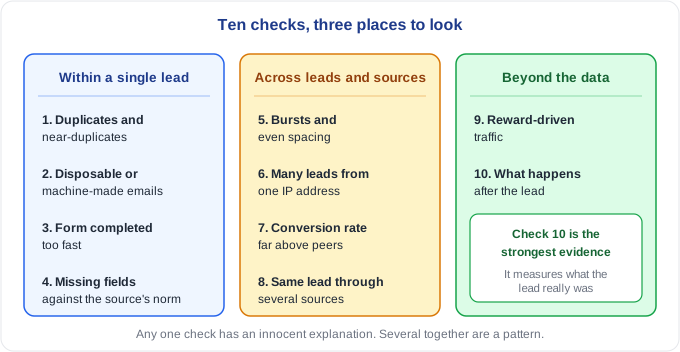
Within a single lead
1. Duplicates and near-duplicates. The same email address or phone number appearing more than once is the obvious case. The less obvious one is variation: capital letters, dots and plus tags can make one Gmail inbox look like five addresses. The email normalization guide explains how to match them without merging real people. A shopper who submits twice is often innocent, so look at whether repeats cluster by source.
2. Disposable or machine-made emails. Addresses at throwaway domains, or local parts that are mostly digits, have no vowels or repeat one character, are common in invented leads. Plenty of real people use throwaway addresses to avoid marketing, so treat this as a hint. The disposable email checklist covers the patterns.
3. A form completed too fast. A long form finished a few seconds after the click suggests nobody read it. This needs both a click time and a conversion time, and the bot lead article explains why timing is so revealing.
4. Missing fields. If a source normally sends a phone number and IP address with every lead, a batch that arrives without them stands out against that source's own history.
Across leads and sources
5. Bursts and even spacing. Real audiences follow daily rhythms. A sudden burst of leads in one hour, or conversions that land almost exactly the same gap apart, can mean a script. A launch or a promotion can cause a burst too, so check what changed.
6. Many leads from one IP address. A household router produces a few people on one address, and a datacenter address behind dozens of different emails looks more like a ring. Offices, campuses and mobile carriers also share addresses, so the number of distinct people matters.
7. A conversion rate far above peers. Compare affiliates on the same offer over the same weeks. A rate far from the rest is worth a closer look, as the conversion rate guide explains, and the same logic applies to earnings per click, which can hide fake leads.
8. The same lead through several sources. In some verticals, real shoppers submit through several sites in an afternoon. In others, the same person appearing under different affiliates suggests one operator running several accounts, or a source that recycles data. The offer's rules decide which reading fits.
Beyond the data
9. Reward-driven traffic. Leads from people paid to complete an offer convert well and behave poorly. They are real people with no intent, which is the subject of the incentivized traffic guide.
10. What happens after the lead. This is the strongest evidence of all. Contact a sample. Note who can be reached, who remembers asking, and who says they never requested anything. Log those outcomes by source, because a source whose leads nobody can reach is telling you something whatever its export looks like.
If you only have ten minutes
You do not have to run all ten checks every time. When time is short, work in this order, because each step narrows what the next one needs to cover.
- Count repeats. Duplicates are quick to find and often the cheapest fraud to remove.
- Group by source. Compare the share of leads that look odd for each affiliate, ad set or placement, so you know where to look.
- Sort by time. Bursts, fast completions and even spacing become obvious once the rows are in order.
- Sample the worst source. Contact a handful of its leads, and a handful from a healthy source for comparison.
Those four steps usually tell you whether there is a problem and where it is. The remaining checks help you understand it.
Trust outcomes over appearances
Not every check carries the same weight.
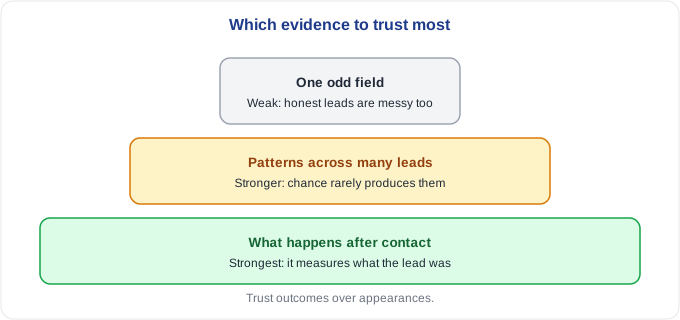
One odd-looking field proves very little, because honest leads are messy too. Patterns across many leads from one source are stronger, because chance rarely produces them. What happens after you contact the lead is the strongest evidence, because it measures what the lead actually was rather than how it looked.
That is why a single flag should start a conversation, not end one. Several signals on the same source, backed by poor outcomes, is a pattern.
From a flag to a decision
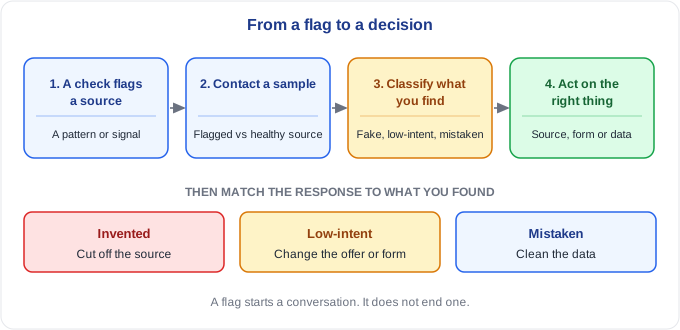
Once a source is flagged, contact a small sample of its leads and compare them with a sample from a healthy source. Classify what you find as invented, low-intent or mistaken, and act accordingly. If you reject leads, give each one a reason, as the lead scrubbing guide recommends, and keep the evidence so the conversation with the partner can stay factual.
Running the checks on a large export
Ten checks across thousands of rows is slow and easy to get wrong by hand, especially the cross-file ones such as repeats over time. If you would like to see which of your own leads trip these checks, send us a recent lead export and we will run every lead through our checks and email you a report showing which ones look suspicious and why, at no cost. A flag means a lead deserves a closer look, and the decision stays with you.
Frequently asked questions
How can you tell if a lead is fake? Look for duplicates and near-duplicates, throwaway or machine-made emails, forms completed unusually fast, bursts and even spacing, many leads behind one IP address, and a conversion rate far above peers. Then confirm with what happens after the lead is contacted.
Is a lead with a disposable email always fake? No. Some real people use throwaway addresses on purpose. It is a hint, and it matters most when it clusters in one source alongside other signals.
What is the best single test for a fake lead? Contacting a sample. Whether the person can be reached and remembers asking is stronger evidence than any pattern in the data.
Should I reject every flagged lead? No. A flag means a lead deserves a closer look. Review the flagged source, sample its leads and give each rejection a reason before you act.
Can software prove that a lead is fake? It can show which leads and sources deserve scrutiny and why. The conclusion comes from your own review and your agreement with the partner.
Spotting fake leads is mostly a matter of looking in the right places and trusting outcomes over appearances.