October 17, 2026
Conversion Lag: Why Real Leads Convert Over Days
What conversion lag is
Conversion lag is the delay between one event and the next one that matters. In lead generation it usually means the time between a lead arriving and the outcome you care about: a first conversation, a qualified lead, an appointment, a sale or an approval.
Lag is normal. A real person who filled in a form on Tuesday may not pick up the phone until Thursday, may compare three quotes first, or may need a document before anything can move forward. If you judge a source on the day its leads arrive, you are judging leads that have not had time to become anything yet.
That cuts both ways. Lag can make an honest affiliate look weak, and it can also hide a weak one for a while. Reading it correctly is one of the most useful skills in lead quality work.
Two clocks, not one
Most confusion comes from mixing up two different time measurements.
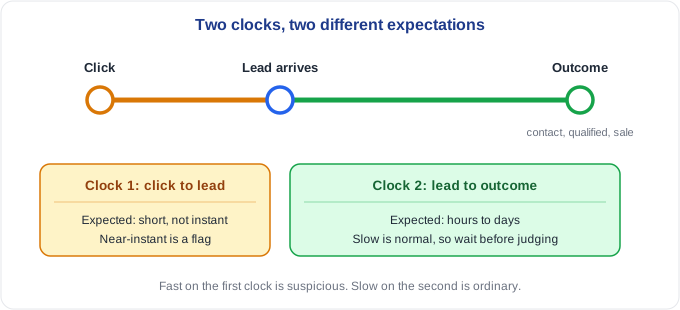
The first clock runs from the click to the lead. A person who read an offer and filled in a form takes a little while, and a form completed in a second or two suggests nobody read it. The bot lead article explains why that first clock is so revealing.
The second clock runs from the lead to the outcome. Here, days are ordinary. A short lag on the first clock is a warning sign. A long lag on the second clock is not.
Keeping the two apart stops you from reading a slow, healthy pipeline as a problem, or a fast, suspicious one as a success.
Why real leads take days
There is no single right number, and it differs a great deal between offers. These are the usual causes.
- Contact attempts. The first call may go to voicemail. Many leads only connect on the second or third try, often at a different time of day.
- Comparison shopping. In insurance, loans and home services, people often request several quotes and respond to the ones they like best.
- Waiting on someone else. A partner, a document, a payday or a decision from another person can add days.
- Process steps. Underwriting, verification and approval take time, whatever the quality of the lead.
- Weekends and time zones. A lead that arrives on a Friday evening may not be worked until Monday.
Your own history is the only reliable guide to what is typical for your offer, so measure it instead of assuming.
The trap: judging a source too early
Suppose two affiliates start on the same Monday. Here is a fictional illustration, with invented numbers, of what happens if you look at their leads three days later.
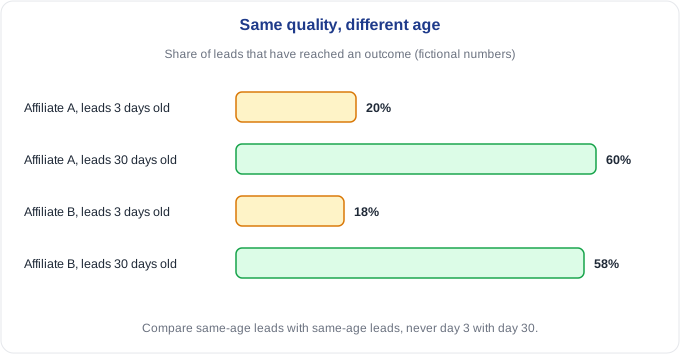
At the early read, only a small share of either affiliate's leads have reached an outcome, because most are still on their way. Compare an affiliate whose leads are three days old with one whose leads are three weeks old, and the older one wins every time, for reasons that have nothing to do with quality.
The fix is to compare leads of the same age. Group them by the week they arrived, then compare each group with others at the same age. This is often called a cohort view. It is a small change to the way you read the export, and it removes most unfair comparisons.
Related mistakes follow from the same cause:
- Pausing a good affiliate because its first week looks weak.
- Declaring a new source a success because its first week looked strong.
- Comparing this month's partial numbers with last month's complete ones.
- Setting a payout rule that rejects leads before they have had a fair chance to convert.
The conversion rate guide covers a related trap, where a rate that looks too good is worth a closer look.
When the lag itself is a signal
Most of the time lag is just lag. Occasionally its shape tells you something.
- No lag at all. Where the offer normally needs days of back and forth, a source whose leads all seem to complete immediately is unusual. Check how the outcome is being recorded.
- Lag that is suspiciously even. Real people vary. If many outcomes arrive at almost the same gap after the lead, that regularity can point to something automated.
- Lag that never ends. A source whose leads never reach a first conversation, however long you wait, deserves a sample call.
- Lag that differs sharply from peers. Compare against other sources on the same offer, since those face the same process steps.
As with any pattern in the data, none of these proves anything about a particular source. They are reasons to look closer. The affiliate fraud detection guide explains how to combine several signals instead of leaning on one.
Read leads in three stages
Because the picture changes as leads age, it helps to decide in advance what you will look at and when.
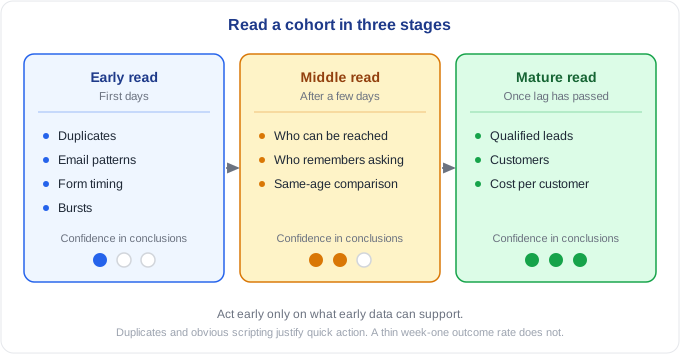
Early: the shape of the lead. Right away, you can check things that do not depend on outcomes: duplicates, email patterns, form timing and bursts. Our checklist for spotting fake leads lists the checks that work at this stage.
Middle: contact outcomes. After a few days, look at who could be reached and who remembers asking. Compare sources at the same age.
Mature: qualified leads and customers. Once your usual lag has passed, compare sources on qualified leads and customers. This is where cost per customer becomes meaningful, and it is the stage the advertiser's guide points to when it explains how to set a payout.
Act early only on what the early data can support. Duplicates and obvious scripting justify quick action. A thin outcome rate in week one does not.
What lag means for payouts and agreements
If you pay affiliates before outcomes are known, you carry the risk of lag. If you wait until outcomes are known, the affiliate carries the cash-flow cost. Most programs end up with a middle path, such as a review window before payment, which is why a clear review period belongs in the agreement. The agreement template guide has sample wording for review windows and for giving a reason with each rejection. The scrub rate guide explains how to report rejections so the affiliate can see what happened.
Keep two things in mind when you set the window. It should be long enough for normal lag to play out, and the rules should be the same for every partner. If the review window is shorter than your typical lag, you will reject leads that would have turned out fine.
A short checklist
- Measure your own lag. For the last few months, find how many days it typically takes from lead to first conversation and from lead to outcome.
- Group leads by arrival week. Compare groups of the same age.
- Separate the two clocks. Fast click-to-lead is a flag. Slow lead-to-outcome is normal.
- Do the early checks early, and leave outcome-based judgments until your usual lag has passed.
- Match the review window to the lag, and write it into the agreement.
- Sample before concluding. Call a few leads from any source that looks odd.
Seeing how your own leads behave
If you would like to see which of your leads trip our checks while you wait for outcomes to mature, send us a recent lead export and we will run every lead through our checks and email you a report showing which ones look suspicious and why, at no cost. A flag means a lead deserves a closer look, and the decision stays with you.
Frequently asked questions
What is conversion lag? It is the delay between a lead arriving and the outcome you measure, such as a first conversation, a qualified lead or a sale.
How long should conversion lag be? It depends on the offer. Measure your own history for each outcome instead of using a general number.
Is a fast conversion always a good sign? No. Speed between the click and the lead can mean nobody read the form. It is the speed from lead to outcome that is usually slow and healthy.
Why does a new affiliate look weak in the first week? Because many of its leads have not had time to reach an outcome yet. Compare leads of the same age before drawing conclusions.
Can lag help find fraud? It can point to leads or sources worth a closer look, for example outcomes that are unusually even, or leads that never reach a conversation. It is one signal among several, and it proves nothing alone.
Give leads time to become something, then judge them by what they became.