October 19, 2026
How to Vet Affiliates Before They Send a Lead
Why vetting comes before the first lead
Most affiliate problems are cheaper to prevent than to unwind. Once a partner is live, sending traffic and expecting to be paid, every concern becomes a dispute. Before the first lead, the same concern is just a question, and you are free to walk away.
Vetting is not about distrust. Most applicants are who they say they are and run honest programs. The aim is to learn how a partner actually gets its traffic, so that you can price and manage it properly, and to filter out the few who are not what they appear to be.
It also does not have to be heavy. A short sequence of questions, a few checks you can run in minutes, and a small pilot will catch most of what matters.
Four stages, from application to scale
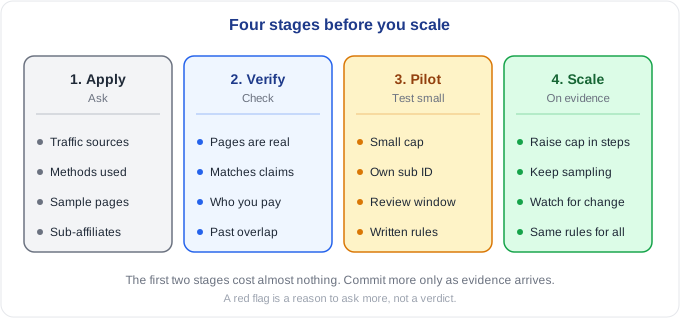
Each stage narrows the risk before you commit more. The first two cost almost nothing, the pilot costs a little, and scaling only happens once the evidence supports it.
Stage 1: Ask good questions on the application
A form that only collects a name and a website tells you very little. Ask for the details that explain where leads will come from.
- Traffic sources. Search, content, email, social, paid ads, a network of sub-affiliates, or something else?
- Methods. How is the traffic generated, and what does the visitor see before the form?
- Sample pages. Links to the pages, ads or emails they plan to use for your offer.
- Experience. Which similar offers have they run, and are there references you can contact?
- Sub-affiliates. Will they pass traffic through other publishers? If so, who, and how is it reported?
The answers matter as much for what they leave out as for what they include. Specific answers, with examples, suggest a partner who knows their traffic. Vague ones suggest it is worth asking again.
Stage 2: Check the claims
Whatever a partner tells you can be checked against something you can see. A few minutes of looking is often enough.
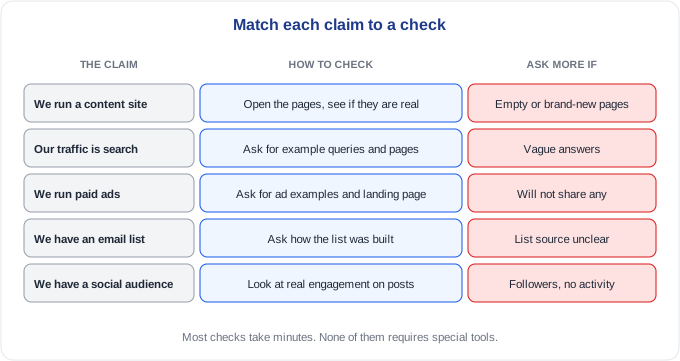
Open the pages the applicant sent you. Look at whether the site is real and active, whether the offer fits the page, and whether the wording makes promises your own rules would not allow. Ask for examples of the queries, ads or messages that bring visitors in, and ask how an email list was built. None of this requires special tools.
Two further checks are worth doing, with a caution. First, find out who you are paying: the legal entity, the payee and the tax details your accountant needs. Ask your accountant or counsel what to collect and how to store it, because rules differ by country. Second, look for overlap with partners you have already removed or declined, such as the same payee, the same pages or the same contact details under a new name. That is one of the ways a ring of accounts appears, as described in the field guide to types of lead fraud.
A red flag at this stage is a reason to ask more questions, not a verdict. If the answers remain thin, it is fine to decline.
Stage 3: Run a pilot, not a launch
Even a well-vetted partner should start small. A pilot gives you real data before the real money is at stake.
Set it up so you can learn from it.
- A small cap. Limit volume or spend so a bad batch is a small problem.
- Its own sub ID. Give the partner a separate identifier so its leads can be reported, capped and paid on their own. The incentivized traffic guide explains why separating sources matters.
- A review window. Agree that leads are reviewed before payment, and long enough for normal lag to play out, as the conversion lag article describes.
- Written rules. Put the permitted sources, the reasons a lead can be rejected and the way you will communicate them in the agreement. The agreement template guide has sample wording.
Tell the partner it is a pilot. Honest affiliates understand and expect it, and the reaction is informative in itself.
Stage 4: Read the first batch
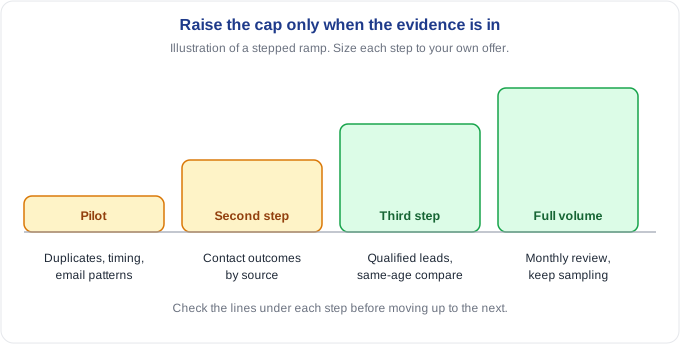
The first batch is where the vetting pays off. Read it in the order that makes sense for its age.
Right away, look at the shape of the leads. Duplicates, throwaway or machine-made email addresses, form completion times, and bursts all show in the first export. Our checklist for spotting fake leads lists the checks.
After a few days, look at outcomes. Contact a sample. Who can be reached, who remembers asking, and how does this compare with a healthy source of the same age?
After your usual lag, look at qualified leads and customers. This is the number that decides the cost of a customer, which is what the advertiser's guide recommends paying attention to.
If the batch matches what the applicant described, raise the cap in steps, and look again at each step. If it does not, the conversation that follows can be specific, using your own data. Reject leads with a reason, as the lead scrubbing guide recommends, so the discussion stays factual.
What to keep doing after launch
Vetting is not a one-time gate. A partner who passes the pilot can still change how it gets traffic.
- Keep sampling. A few contacted leads each month show whether quality has held.
- Watch for sudden changes. A jump in volume, a shift in timing patterns or a change in sub ID mix is a reason to ask what changed.
- Review the sources. Ask again how the traffic is generated whenever the numbers move.
- Apply the same rules to everyone. Consistent treatment keeps the process fair and defensible.
The affiliate fraud detection guide explains how to combine signals so that a single odd number does not turn into an accusation.
A short checklist
- Ask specific questions about sources, methods, sample pages and sub-affiliates.
- Check what you can see: the pages, the offer fit and the stated sources.
- Know who you are paying, and take advice on what to collect.
- Look for overlap with partners you have already declined or removed.
- Run a pilot with a small cap, its own sub ID and a review window.
- Read the first batch in stages, and raise the cap in steps.
- Keep sampling after launch.
Putting your pilot to the test
If you have a new partner's first batch in hand, a recent export is the quickest way to see how it looks. Send us a recent lead export and we will run every lead through our checks and email you a report showing which ones look suspicious and why, at no cost. A flag means a lead deserves a closer look, and the decision stays with you.
Frequently asked questions
How do you vet an affiliate? Ask specific questions about traffic sources and methods, check the pages and claims you can see, confirm who you are paying, and run a small pilot with its own sub ID before you scale.
What questions should I ask a new affiliate? How they generate traffic, what the visitor sees before the form, which pages or ads they will use, what similar offers they have run, and whether they use sub-affiliates.
Is a pilot really necessary for an experienced affiliate? It is still worthwhile. A small cap and a review window cost little, and they show how this partner performs on your offer specifically.
What is a red flag on an affiliate application? Vague answers about traffic, reluctance to share any example pages or ads, or overlap with partners you have declined. Treat each as a reason to ask more, not as proof.
How long should a pilot last? Long enough for your usual lag to pass, so that you can compare outcomes with other sources of the same age.
Vetting works best as a conversation: ask clearly, check what you can, and let a small pilot confirm it.