October 24, 2026
Affiliate Fraud Software: What to Look For
"Affiliate fraud software" means several different things
Search for affiliate fraud software and you will find tools that do quite different jobs under similar names. Some filter traffic before a visitor reaches your page. Some check a form as it is submitted. Some score the leads after they arrive, and some track what the leads turned into. All of them are reasonably described as fraud tools. They are not interchangeable.
The first decision is not which product to buy. It is which gap you are trying to close. A program troubled by bots on paid traffic needs something different from one whose problem is leads that arrive and never convert. Buying a tool that looks in the wrong place is the most common way to spend money on fraud software and see little change.
Where each kind of tool looks
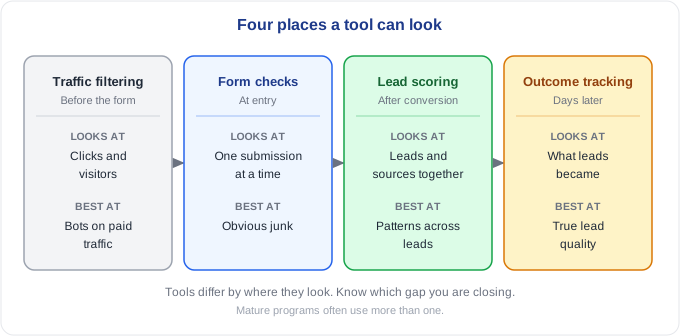
Traffic filtering looks at clicks and visitors before they reach the form. It is best at automated traffic on paid campaigns. It cannot tell you whether a person who really did fill in a form had any intent.
Form checks look at a single submission as it happens: whether an email address is well formed, whether a field is empty. They catch obvious junk at the door, but one lead on its own tells you little about a source.
Lead scoring after conversion looks at leads and sources together, once the leads have arrived. It is best at patterns that no single lead reveals, such as duplicates, bursts, timing and one source standing out against its peers. The field guide to types of lead fraud explains which patterns show up at which level.
Outcome tracking looks at what the leads became: contacted, qualified, sold. It is slow, because outcomes take days, but it is the most direct measure of quality. The conversion lag article explains why.
A mature program often uses more than one. The aim is to know which kind you have, and what each one does not see.
Questions worth asking any vendor
Whatever the category, a handful of questions separate a useful tool from a vague one.
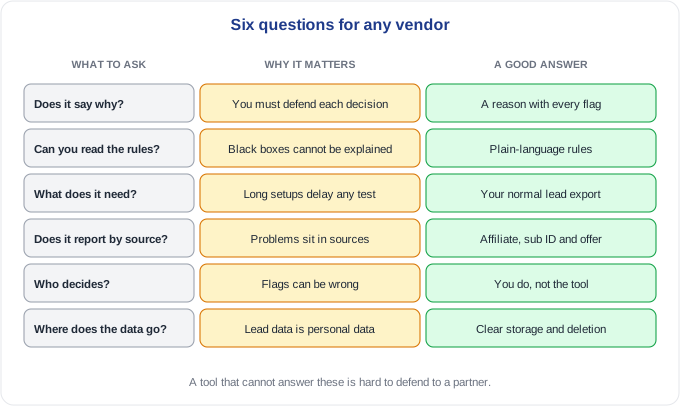
Does it tell you why? A score on its own cannot be defended in a conversation with a partner. A reason attached to each flagged lead can. If the tool says a lead is suspicious but not why, you will end up redoing the analysis by hand before you can act.
Can you see the rules? Some tools are black boxes. Others use plain rules you can read, such as "form completed in under three seconds" or "many leads from one address in an hour". Rules you can read can be questioned, adjusted and explained to a partner.
What does it need from you? The best fit uses data you already have, such as an export with timestamps, emails and a source column. A tool that needs a long integration before it can show anything is harder to test.
Does it report by source? Problems sit in sources, not in individual leads, so a tool should group results by affiliate, sub ID and offer. The scorecard guide shows why, and the sub-affiliate article shows what it can reveal.
Who decides? Flags can be wrong. Honest tools describe their output as a reason to look closer. If a product promises certainty about a specific lead, treat that with caution.
Where does the data go? Lead data is personal data. Ask what is stored, for how long, who can see it, and whether you can have it deleted. Ask your own counsel what your obligations require.
Red flags in the sales pitch
Some claims are worth treating with caution.
- "Catches all fraud." No tool does. Ask what it does not see.
- A score with no explanation. You cannot take it to a partner.
- No way to try it on your own leads. A demo on sample data tells you little about your traffic.
- Vague descriptions of how it works. You do not need the source code, but you do need to understand the logic.
- Automatic rejection by default. Decisions about partners and payouts should stay with a person.
What software cannot do
Even a good tool has limits, and it helps to be clear about them.
It cannot prove that a specific lead is fake. It can show which leads and sources deserve scrutiny, and why. The conclusion comes from your review and your agreement with the partner.
It cannot replace outcomes. A flagged lead may be fine, and an unflagged lead may be poor. Contacting a sample, as the checklist for spotting fake leads recommends, remains the strongest evidence.
It cannot fix a weak agreement. If the contract does not say what counts as a rejectable lead, software will not settle the dispute. The agreement template guide and the payout disputes guide cover that side.
Test it on your own leads
The most useful evaluation is a short, honest test.
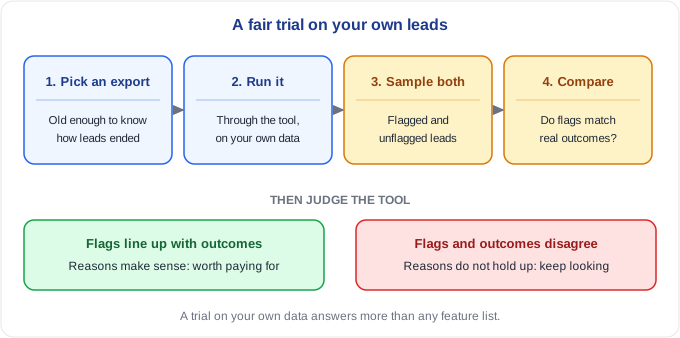
- Pick a past export old enough that you know how the leads turned out.
- Run it through the tool.
- Sample both sides. Look at a handful of flagged leads and a handful of unflagged ones.
- Compare with outcomes. Do the flagged leads really behave worse? Do the reasons make sense to you?
If the flags line up with what you already know, and the reasons hold up, the tool is finding something real. If they disagree with outcomes, or the reasons do not make sense, keep looking. A trial on your own data answers more than any feature list.
Matching the tool to the problem
A rough guide to start from:
- Bots on paid campaigns: traffic filtering is the right place to start.
- Obvious junk at entry: form checks are cheap and sensible.
- Leads that arrive and do not convert, and partners you need to compare: post-conversion scoring by source.
- Not sure where the problem is: begin with outcomes by source, then decide.
Pair the tool with a routine, such as the monthly review in the payout reconciliation guide, so that its output turns into decisions.
A short checklist
- Decide which gap you are closing: traffic, entry, leads or outcomes.
- Ask for a reason with every flag.
- Prefer rules you can read.
- Check it works from your normal export.
- Look for reporting by source and sub ID.
- Ask where the data goes.
- Test it on past leads before you commit.
See how it looks on your own data
If you want to see what a post-conversion check finds, send us a recent lead export and we will run every lead through our checks and email you a report showing which ones look suspicious and why, at no cost. A flag means a lead deserves a closer look, and the decision stays with you.
Frequently asked questions
What is affiliate fraud software? It is a general name for tools that look for fake, duplicate or low-quality traffic and leads in affiliate and lead generation programs. They differ in where they look: before the form, at submission, after the lead, or at outcomes.
Which type of fraud tool do I need? It depends on where your problem is. Bots on paid traffic call for traffic filtering. Leads that never convert call for post-conversion scoring and outcome tracking.
Can software detect all affiliate fraud? No. It can show where to look and why. Confirmation comes from your own review and from outcomes.
What should a good tool show me? A reason for each flag, results grouped by source, and rules you can read and explain.
How should I evaluate a tool? Run it on a past export where you already know the outcomes, sample flagged and unflagged leads, and see whether the flags and reasons hold up.
The best fraud software is the one whose output you can explain to a partner, and defend afterwards.