October 21, 2026
Affiliate Payout Disputes: A Fair Process
Why payout disputes happen
A payout dispute rarely starts with someone acting in bad faith. Far more often, the two sides are counting different things. One side counts leads by the day they were sent, the other by the day they were accepted. A tracking call failed and a lead never arrived. A lead was rejected as a duplicate and the affiliate has never seen the match. A review window ended before a lead had time to turn into anything.
Some disputes are different. A source has sent leads that do not hold up, you have rejected them, and the partner disagrees. Those are harder, and they are exactly where a fair, written process matters most. It keeps the conversation on evidence, protects the relationship where the partner is honest, and leaves you with a record where it is not.
This guide covers a simple process that works whichever kind of dispute you have. It is a practical approach, not legal advice. Your agreement decides what each side is entitled to, so ask counsel if a dispute is large or the wording is unclear.
Five principles of a fair process
- Rules first. The dispute window, the review period and the reasons a lead can be rejected should already be in the agreement before any dispute starts. The agreement template guide has sample wording.
- One standard for everyone. Apply the same rules, with the same timing, to every partner. Inconsistent handling is hard to defend and tends to cause the next dispute.
- A reason for every rejection. A rejection without a reason cannot be checked, so it cannot be accepted. The lead scrubbing guide explains how to record them.
- Evidence from both sides. You show why you decided what you did, and the partner shows why they disagree. Neither side's say-so is enough on its own.
- Time limits. A window for the partner to raise a dispute, and a time for you to respond. Open-ended disputes damage trust quickly.
The process, step by step
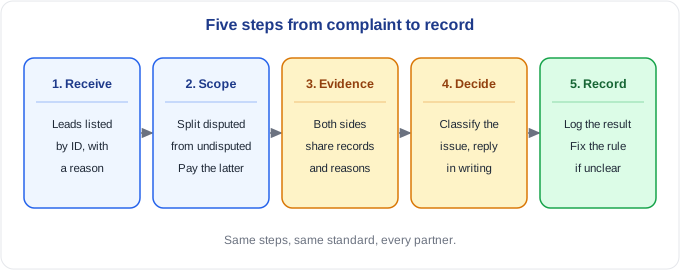
1. Receive it in a standard form. Ask the partner to list the leads in dispute by ID, say which statement line they relate to, and give their reason. A dispute that says "the numbers look low" cannot be investigated. One that lists forty lead IDs and says why can.
2. Scope it. Separate the leads in dispute from those that are not. Pay the undisputed part on the normal date, and keep the disputed part open. Holding the whole statement because of a few leads turns a small disagreement into a big one.
3. Exchange evidence. Share what you have: the rejection reason, the matching key for a duplicate, the timing, the checks that flagged the lead and how a sample of the leads turned out. Ask for what the partner has: their traffic description, the pages or offer screens a visitor saw, and their own tracking logs.
4. Decide and reply in writing. Classify the issue, say what you decided and why, and say what happens next. Where the partner is right, say so, and correct it promptly. Where you stand by the rejection, show the reason again, with the evidence.
5. Record and learn. Log the outcome. If the dispute came from unclear wording, fix the wording. If it came from a tracking problem, fix the tracking. Otherwise the same dispute will return next month.
Who brings what
Different disputes call for different evidence. It helps to know in advance what each side should be able to show.
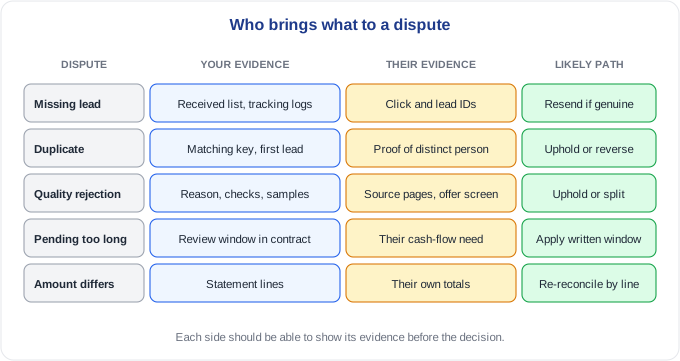
A missing lead is usually a tracking question, and the postback tracking article explains why those happen. A duplicate dispute turns on the matching key, so it helps to match leads as the email normalization guide describes. A quality rejection is the most judgment-heavy, and your evidence should include more than appearance: how a sample of the leads actually turned out, compared with a healthy source.
A dispute over timing, where a lead is still pending, is often settled by the written review window. The conversion lag article explains why real leads need days, and why a window shorter than your usual lag leads to unfair rejections.
An amount that differs from the partner's own total is usually fixed by reconciling line by line. The payout reconciliation guide shows how.
Do not hold the whole payout hostage
The most useful single habit is to separate the undisputed part from the rest.
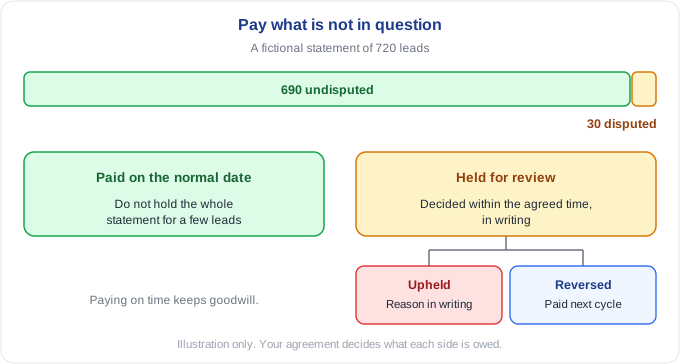
Paying what is not in question, on time, keeps goodwill and shows that you are acting in good faith. The disputed part is decided within the time you agreed. If you uphold a rejection, give the reason in writing. If the partner was right, add the leads to the next payout without delay.
Keep in mind that exceptions exist. If you have strong evidence that a whole source is not genuine, you may have good reasons, under your agreement, to hold more. That is where advice from counsel earns its fee, and where the quality of your records matters most.
Handling a dispute about a flagged source
When the disagreement is about quality, a few habits help.
- Lead with the sample. Contact a handful of the leads in question, and a handful from a healthy source, and share what you found. Outcomes persuade better than assertions.
- Avoid labels. Describe what you saw. Do not call a specific lead or partner fraudulent. A flag means a lead deserves a closer look, and the decision stays with you.
- Offer a route forward. A source can often be fixed: change the form, drop a sub ID, or take a source out. That serves both sides better than a standoff.
- Check your own side. Confirm that your rule was in the agreement, and that you applied it as you do for other partners. The guide to vetting affiliates and the affiliate scorecard both help to show what was agreed and what changed.
When it cannot be settled
Some disputes do not resolve. The agreement should say what happens next, whether that is escalation to named people, mediation, or something else. If a dispute reaches that point, take advice from counsel, keep your records together, and keep communication factual.
A short checklist
- Put the rules in writing before any dispute.
- Ask for disputes in a standard form, with lead IDs and a reason.
- Scope the dispute, and pay the undisputed part on time.
- Exchange evidence from both sides.
- Reply in writing with the decision and the reason.
- Apply the same standard to every partner.
- Record the outcome, and fix the cause.
Strengthening your evidence
Disputes go better when your evidence is ready before you need it. If you would like to see which of your leads trip our checks, and why, send us a recent lead export and we will run every lead through our checks and email you a report showing which ones look suspicious and why, at no cost. A flag means a lead deserves a closer look, and the decision stays with you.
Frequently asked questions
What is an affiliate payout dispute? It is a disagreement between an advertiser or network and an affiliate about what is owed, usually about leads that were not counted, were rejected, or are still pending.
Should I pay while a dispute is open? Many programs pay the undisputed part on time and hold only the disputed leads. Your agreement decides, and counsel can advise on larger disputes.
What evidence should I keep? The raw exports, your matching and rejection records with reasons, any sample outcomes, and every statement and message exchanged with the partner.
How long should a dispute window be? Long enough for the partner to review the statement, and short enough that matters stay fresh. Write the number of days into the agreement.
What if the partner was right? Say so, fix it quickly, and look at why it happened so it does not recur.
A fair process does not guarantee agreement. It does make the disagreement specific, and it leaves a record both sides can check.