October 22, 2026
Sub-Affiliate Fraud: When Traffic Gets Passed Along
What sub-affiliates are, and why they change the risk
A sub-affiliate is a publisher who sends traffic through another affiliate instead of working with you directly. It is a normal arrangement. Large affiliates and networks recruit smaller publishers to widen their reach, and many perfectly good programs depend on it.
It does change one thing: how much you can see. You vetted the partner you signed. You probably did not vet the sites, ads, email lists and social accounts underneath that partner, and in some cases the partner has not looked closely at them either. Whatever quality those sources have, it arrives in your lead export under one partner's name.
The risk is not that sub-affiliates are bad. It is that a problem can sit one layer below where you are looking, behind a partner whose name you trust.
Visibility fades with every layer
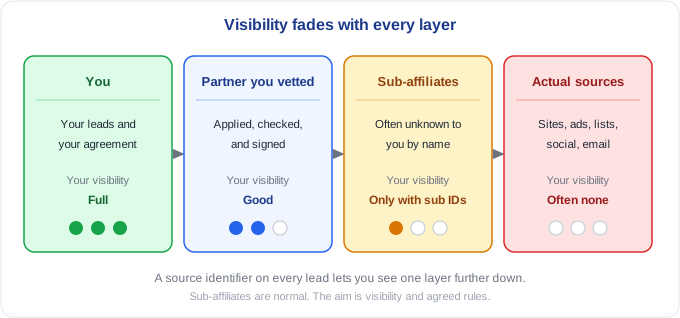
At the top you see your own leads and your own agreement. At the partner level you have what you learned during vetting, and the partner's reputation. Below that, the picture depends on whether the partner passes along a source identifier for each sub-affiliate. Without one, everything below the partner looks like a single source. With one, you can see inside it.
Fraud is only one reason this matters. Even honest sub-affiliates can run traffic the partner would never allow, such as incentivized or pre-ticked offers. The incentivized traffic guide explains why that is a quality issue, not just a rules issue.
How a problem hides behind a good partner
Several patterns come up in programs with sub-affiliates. None of them means the partner is acting in bad faith, and most are ordinary growing pains.
- One weak sub inside a healthy total. A single poor source is averaged with good ones, so the partner's overall numbers look fine.
- Sources the partner never checked. Recruiting subs quickly can outrun the partner's own vetting.
- Re-labelling. A source that was removed from one partner's traffic reappears under another, or under a new sub ID.
- One operator, several identities. A set of accounts that look independent but share data, which the field guide to types of lead fraud describes as a ring of accounts.
- Blank sources. Leads that arrive with no sub ID, so there is nothing to compare.
What it looks like in the data
You do not need special tools to start. Most of the signs are visible in a lead export with a sub ID column.
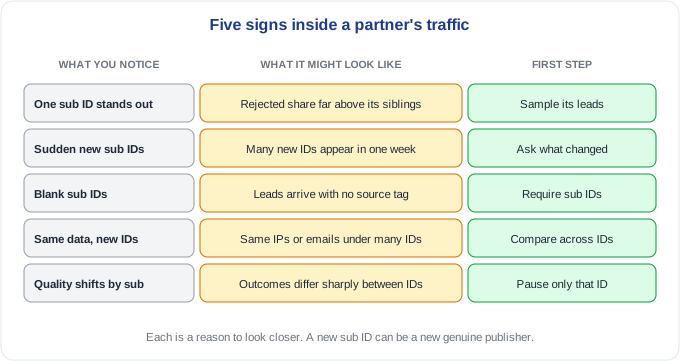
The most useful single habit is to report quality by sub ID, not just by partner. Duplicate share, rejected share, contact rate and qualified rate can all be broken down by source, and the affiliate scorecard guide shows how to lay them out. A sub ID that sits far from its siblings is the place to look first.
As always, a sign is a reason to look closer, not a verdict. A new sub ID may simply be a new, genuine publisher. The checklist for spotting fake leads lists the checks that help you tell the difference.
A fictional example
Suppose a partner sends 1,200 leads in a month through five sub IDs. Here are the invented numbers.
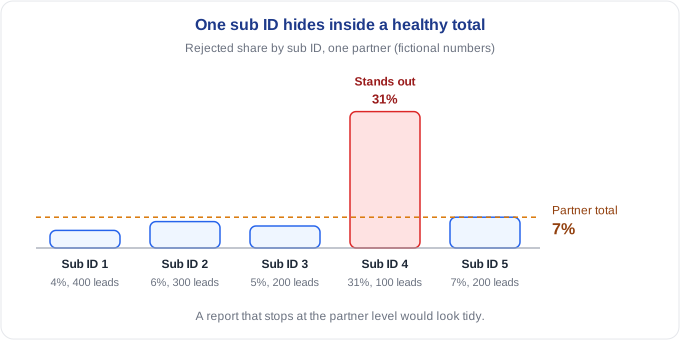
Four of the five sub IDs have rejected shares between 4% and 7%. One has 31%. Because it is only a small part of the volume, the partner's total comes out at about 7%, which looks healthy in a report that stops at the partner level.
Without the sub ID, you would see a tidy partner. With it, you can see where the issue sits. And you have a better conversation to have: not "your traffic is bad", but "this one source is performing very differently from the others, can we look at it together?"
What to put in the agreement
Most of the control comes from the agreement, written before a problem exists. The agreement template guide has sample wording. For sub-affiliates, consider asking for the following, and take advice from counsel on the right terms for your situation.
- Disclosure. The partner states whether it uses sub-affiliates, and lists them on request.
- Source identifiers. A unique sub ID passed with every lead, so that sources can be reported separately.
- Approval for new sources. Material changes, such as adding a new type of traffic, need your agreement first.
- Responsibility. The partner is responsible for the traffic of its sub-affiliates, to the same standard as its own.
- A way to remove one source. You can pause a single sub ID without ending the whole relationship.
- Reasons with rejections. The usual rule applies: every rejection gets a reason, as the lead scrubbing guide explains.
Cut the source, not the relationship
When one sub ID is the problem, the fairest and usually the most effective response is to deal with that source alone.
- Share the data. Show the partner the sub ID and the numbers, along with how a sample of its leads turned out.
- Ask what it is. Partners often know exactly which publisher it is, and are glad to learn of an issue.
- Pause that ID. Remove or cap the single source while the question is open.
- Watch for re-appearance. If a removed source returns under a new ID, that is a conversation to have, with evidence.
If a payout dispute follows, the payout disputes guide explains how to keep it factual. And when you take on a new partner who plans to use sub-affiliates, the guide to vetting affiliates explains what to ask at the start.
A short checklist
- Ask whether the partner uses sub-affiliates, before launch.
- Require a sub ID with every lead.
- Report quality by sub ID, not just by partner.
- Compare each sub ID with its siblings.
- Sample the outliers before concluding anything.
- Pause one source, not the whole partner, where you can.
- Write it all into the agreement.
Looking inside a partner's traffic
If you have an export that includes sub IDs, you can see how the sources compare. Send us a recent lead export and we will run every lead through our checks and email you a report showing which ones look suspicious and why, at no cost. A flag means a lead deserves a closer look, and the decision stays with you.
Frequently asked questions
What is sub-affiliate fraud? It is poor or fabricated traffic that reaches you through a sub-affiliate, a publisher working under another affiliate, where it is harder for you to see the source.
Are sub-affiliates a bad sign? No. Many legitimate programs use them. The point is to have visibility and agreed rules.
How do I see which sub-affiliate sent a lead? Require a unique sub ID with every lead, and report quality by that ID.
Should I remove the partner when one sub ID is poor? Usually it is fairer and more effective to pause that single source, share the data and keep the partner. Your agreement decides what you can do.
What if a removed source comes back under a new ID? Raise it with the partner, using your records. Matching data such as repeated emails or IP addresses can help show the connection.
You cannot manage what you cannot see, so the first step is to see one layer further down.