October 25, 2026
Same Phone, Different Names: A Ring Signal
The pattern
You sort a lead export by phone number and find the same number on several rows. The names are different. Maybe the emails are different too. The question is what that means.
Sometimes it means very little. Sometimes it is one of the clearer signs that a source is not what it appears to be. The same pattern fits both, and the useful skill is telling which one you are looking at before you act.
The field guide to types of lead fraud describes a ring of accounts as one operator making many identities look like independent people. A shared phone number is one of the few details that is hard for such an operator to vary, because a real, working number is harder to invent than a name. That is why it is worth checking. It is also why it must be checked with care, since plenty of honest people share a phone.
First, make the numbers comparable
Before you can find repeats, the numbers have to be written the same way. The same number can appear as (555) 010-1234, 555-010-1234, 5550101234 and +1 555 010 1234.
Reduce each number to digits only, and apply one rule for country codes and leading digits, so that all four forms become the same string. This is the phone equivalent of the approach in the email normalization guide: remove variation that carries no meaning, and then match.
Two cautions. First, do not merge numbers that are merely similar. A single different digit is a different number, or a typo, and deserves a separate look. Second, set aside obvious placeholders such as a number made of one repeated digit or a simple sequence. Those are junk, but they are a different problem from a shared real number, and mixing them in will inflate your counts.
Innocent reasons to share a number
Many perfectly honest leads share a phone.
- A household. A couple or a family share a mobile or a landline, and each fills in a form for their own reasons.
- An office or assistant. A receptionist or an assistant submits requests on behalf of several people at one business.
- An agent or helper. A relative, advisor or caseworker fills in forms for someone else, using their own number.
- A typo or a swap. A person enters a friend's number by mistake, or an old number that has since been reassigned.
- A returning person with a different name form. "Bob" and "Robert", or a married and a maiden name.
None of these is a problem for your program. A rule that rejects every shared number would reject real customers.
When the pattern looks different
The cluster looks different when it does not fit those explanations. Several features, together, point toward a ring.
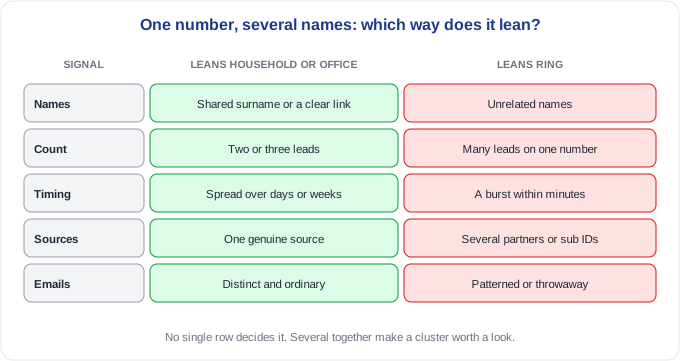
Names. Relatives usually share a surname, or at least a plausible link. A set of unrelated names on one number is less natural.
Count. Two or three people on a number is common. Many more is unusual, especially for a consumer phone.
Timing. Household submissions tend to be spread over days or weeks. A burst of different names within minutes looks more like one person at a keyboard.
Sources. A number appearing through one genuine source over time is one thing. The same number turning up under several partners or sub IDs is another, and may show a source being recycled or an operator using several accounts. The sub-affiliate article explains how that happens.
Emails. Distinct, real-looking emails suggest distinct people. Emails built to a pattern, or at throwaway domains, point the other way. The disposable email checklist covers the patterns.
No single feature settles it. Several together are what make a cluster worth a closer look.
A way to investigate a cluster
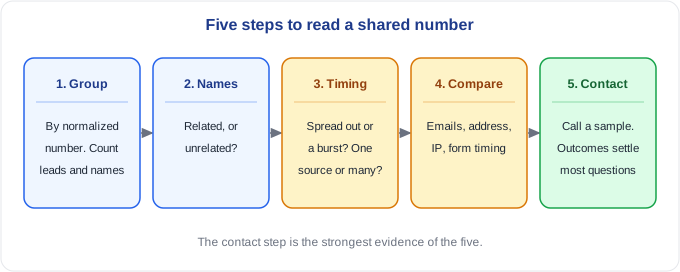
- Group by the normalized number. Count the leads and the distinct names for each.
- Look at the names. Is there a plausible relationship, or are they unrelated?
- Look at time and source. Spread over weeks through one source, or a burst, or several sources?
- Compare the other fields. Emails, addresses, IP addresses and form timing. Shared details across the cluster add weight.
- Contact a sample. Calling the number, or the people, often settles it. Who answers, and what do they say about the form?
The contact step matters most. The checklist for spotting fake leads explains why outcomes are stronger evidence than appearances.
A fictional example
Here are two invented clusters.
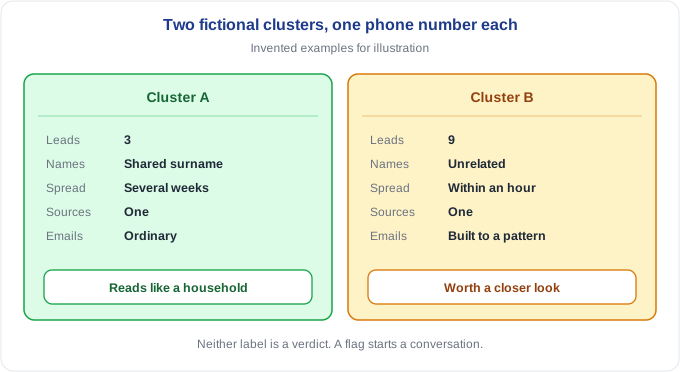
Cluster A has three leads, a shared surname, a spread of several weeks, one source and ordinary emails. That reads as a household, and nobody needs to do anything.
Cluster B has nine leads, unrelated names, all within an hour, emails built to a pattern and a single source. That deserves a closer look: sample the leads, ask the source about the form, and compare with the source's other batches.
Neither label is a verdict. A flag means a cluster deserves a closer look, and the decision stays with you.
What to do about it
- Do not reject by count alone. A rule that removes all shared numbers will also remove real households.
- Define duplicates in the agreement. Say whether a repeat number within a set time counts as a duplicate, and how you will treat different names on one number. The agreement template guide has sample wording.
- Report by source. A shared-number rate that is much higher for one source than its peers is the real signal, and the scorecard guide shows how to lay it out.
- Give a reason with every rejection. The lead scrubbing guide explains how, so the conversation with the partner stays factual.
- Treat contact data carefully. Phone numbers are personal data, so ask counsel what applies to how you store and use them, and to calling them.
A short checklist
- Normalize numbers to a single form first.
- Set aside placeholders such as repeated digits.
- Count distinct names per number.
- Read the cluster: names, count, timing, sources, emails.
- Compare across sources, not just within one.
- Contact a sample before concluding.
- Define the rule in the agreement.
Check your own export
Shared numbers are quick to find once an export is normalized. If you would like to see which of your leads trip this and our other checks, send us a recent lead export and we will run every lead through our checks and email you a report showing which ones look suspicious and why, at no cost. A flag means a lead deserves a closer look, and the decision stays with you.
Frequently asked questions
Is the same phone number on different leads a sign of fraud? Not by itself. Households, offices and helpers often share a number. It becomes more meaningful when there are many unrelated names, a burst of timing, or several sources involved.
How many leads per phone number is too many? There is no universal number. It depends on your vertical, so measure your own normal and compare each source with its peers.
How do I match phone numbers reliably? Reduce them to digits only, apply one rule for country codes, and match on the result. Do not merge numbers that merely look similar.
What is a ring in lead generation? A group of accounts or identities, run by one operator, that look independent. Shared details such as phone numbers, IP addresses or emails can reveal one.
Should I call the number? Often yes, on a sample. Who answers and what they say about the form is strong evidence. Take advice from counsel on the rules that apply to calling.
A shared number is a question, not an answer. The answer comes from what surrounds it.