October 28, 2026
Affiliate Clawbacks: Reversing Payment for Bad Leads
What a clawback is
An affiliate clawback is a reversal of a payment that has already been made. You paid for leads, and later you find that some of them should not have been paid for, so you recover the money, usually by deducting it from a future payout or by asking for repayment.
It is different from a rejection, which happens before money moves, and different from a review window, which delays payment while leads prove themselves. A clawback comes last. The money has gone, the partner has probably spent it, and the conversation is harder for both sides.
That is why clawbacks deserve a careful, written approach. Used well, they protect a program from late-discovered problems. Used carelessly, they damage relationships with honest partners and invite disputes you may not be able to win.
This is a practical guide, not legal advice. Whether and how a clawback can be enforced depends on your agreement and on the law where you and the partner operate, so ask counsel before relying on one.
Three tools, rising friction
Think of clawbacks as the last of three tools for dealing with leads that turn out badly.
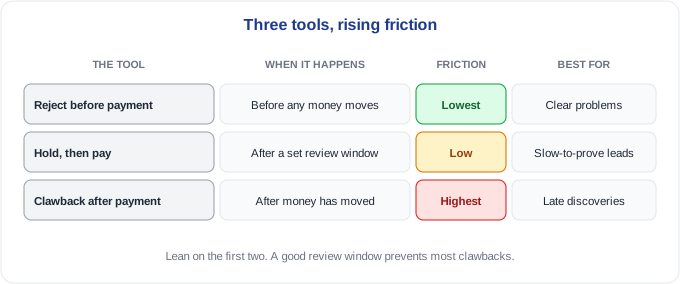
Reject before payment. The easiest and the cleanest. Nothing has to be recovered, and the partner sees a reason on the statement. The lead scrubbing guide explains how to do it well.
Hold, then pay. A review window lets leads reach an outcome before you pay. It is the usual answer to slow-to-prove leads, and the conversion lag article explains why real leads need days.
Clawback after payment. The most friction, and the best reserved for problems that could not reasonably have been found earlier.
Most programs should lean on the first two. A good review window prevents far more clawbacks than any clause can enforce.
When a clawback is fair
A clawback is easiest to defend when it fits a reason both sides agreed in advance. Examples that programs commonly define include:
- Duplicates found later. The same person was counted more than once, and the match only became visible after payment.
- Leads shown to be invalid. Evidence emerges that a set of leads was not what it appeared to be, for instance because the contact details were fabricated.
- A source breach. Traffic came from a source the agreement prohibited, such as a method the partner agreed not to use, and this only came to light afterwards. The sub-affiliate article shows how such a source can hide.
- A downstream reversal. In programs that pay on an outcome, the outcome is reversed within an agreed period.
A clawback is much harder to defend for ordinary performance. If leads simply convert less well than hoped, that is business risk, and unless the agreement says otherwise, it does not entitle you to take payment back.
What the clause should contain
If you want the option of a clawback, the agreement has to carry it. A fair clause usually covers six things.
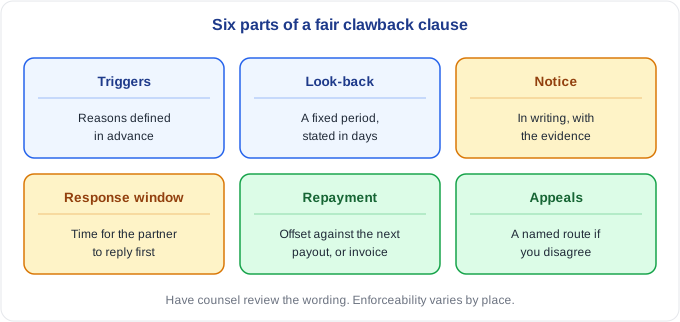
Triggers. The specific reasons a payment can be reversed, written plainly. "Any reason we choose" is the kind of wording that causes disputes.
A look-back period. A fixed number of days after payment, after which the payment is settled. Without one, the partner carries open-ended risk, and the clause is harder to defend.
Notice and evidence. A written notice naming the leads and the reason, with the evidence you rely on.
A response window. Time for the partner to answer before anything is deducted.
Repayment. Whether the amount is offset against future payouts, or invoiced if the relationship has ended.
An appeals route. A named way to escalate if the partner disagrees. The payout disputes guide describes a process that fits here.
The agreement template guide has sample wording for related clauses. Have counsel review the final text for your jurisdiction, because enforceability varies.
How a clawback fits the timeline
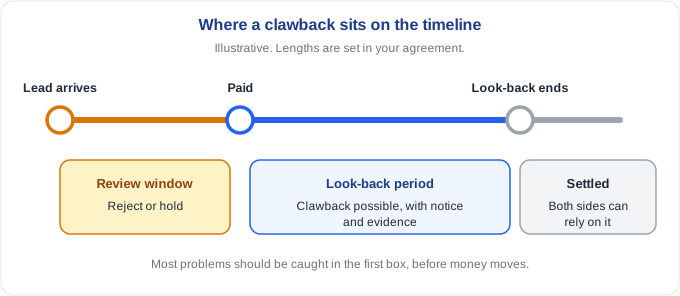
The review window comes first and is where most problems should be caught. After payment, the look-back period gives you a defined time to act on anything that surfaces late. When it ends, the payment is settled and both sides can rely on it.
The lengths are set by your agreement and your offer. They should reflect how long outcomes take to appear, which is the lesson of the conversion lag article, and they should be the same for every partner.
Running a clawback, step by step
When you have a real case, a careful sequence protects both sides.
- Check the evidence. Confirm that the issue fits a defined trigger. Match the leads, sample the outcomes and compare with other sources, as the checklist for spotting fake leads describes.
- Check your own side. Was the lead inside the look-back period, and did you apply the same rule to others?
- Send a written notice. Name the leads, the reason and the evidence. Avoid labels about people or partners, and describe what you found.
- Allow a response. Give the agreed window, and read the reply properly. Partners often have information you do not.
- Decide in writing. Reverse only what the evidence and the agreement support, and say so.
- Settle simply. Offset against the next payout where possible, since it is quicker and less adversarial than an invoice.
- Record it and learn. Log the case, and ask why it was found late. Often the right fix is an earlier check or a longer review window.
A flag from a tool or a report means a lead deserves a closer look, and the decision stays with you. A clawback needs evidence you can show, not a score.
Preventing the need for one
The best clawback is the one you never need.
- Vet partners before launch, and run a small pilot first. The guide to vetting affiliates explains how.
- Match the review window to your lag, so that problems appear before payment.
- Report quality by source every month. A scorecard, as in the affiliate scorecard guide, catches drift while it is small.
- Reconcile each month. The payout reconciliation guide shows how to give every gap a label before you pay.
A short checklist
- Prefer rejection and review windows to clawbacks.
- Define the triggers in the agreement.
- Set a fixed look-back period, the same for every partner.
- Give written notice with evidence.
- Allow a response before deducting anything.
- Settle by offset where you can.
- Take advice from counsel on the wording and on enforcement.
Catching problems before payment
Clawbacks are costly because the problem was found late. If you want to see which of your leads trip our checks before you pay, send us a recent lead export and we will run every lead through our checks and email you a report showing which ones look suspicious and why, at no cost. A flag means a lead deserves a closer look, and the decision stays with you.
Frequently asked questions
What is an affiliate clawback? It is the reversal of a payment already made to an affiliate, usually because leads were later found not to qualify under the agreement.
Is a clawback the same as a chargeback? They are similar in effect. Terms vary between programs, so the agreement should say exactly what applies and when.
Can I claw back payment for low-quality leads? Only if the agreement defines the reason and the leads fall within it. General underperformance is normally business risk, and counsel can advise on your own terms.
How long should the look-back period be? Long enough for your usual outcomes to appear, and fixed in days in the agreement. It should be the same for every partner.
Is it better to hold payments or to claw them back? Holding is usually easier on both sides, because nothing has to be recovered. Many programs use a review window first and keep clawbacks for late discoveries.
A clawback is a last resort. The more care goes into the review window, the less often you will need one.