October 27, 2026
Name Field Patterns That Suggest Scripted Input
Names are the most human field on the form, and the easiest to get wrong
A name field looks like an easy place to spot a fake. In practice it is the field where it is easiest to be unfair. Real names are enormously varied: short ones, long ones, single names, hyphenated names, names with accents and apostrophes, names from every culture and language. A rule that treats an unfamiliar name as suspicious will reject real customers, and will do so disproportionately for people whose names are less common where you operate.
So this guide starts with a principle. You are looking for patterns in how a field was filled in, never for names that look unusual. A name that is rare, foreign to you or hard to spell is not a signal. A name that is plainly a placeholder, a run of keys or a repeat across dozens of leads can be.
Name patterns also prove little on their own. They are best read alongside the other checks in the checklist for spotting fake leads, as one of several clues in the same source.
Three groups of patterns, and one group to leave alone
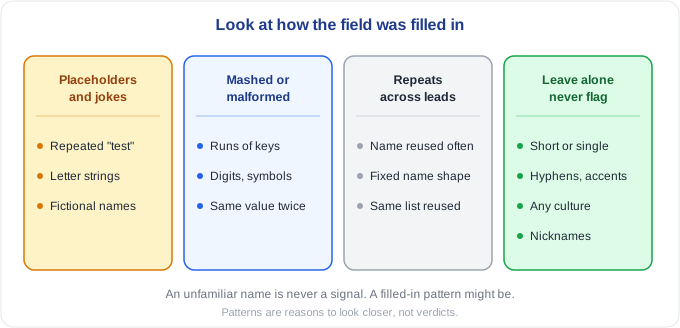
Placeholders and jokes. Entries such as a repeated "test", a string of letters like "asdf", or a famous fictional character. People type these to get past a required field, to avoid giving their details, or as a prank. Scripts use them too.
Mashed or malformed entries. A run of adjacent keys, a name containing digits or symbols, a single letter in both fields, or the same value in the first and last name boxes.
Repeats across leads. The same name arriving many times with different emails, or a set of names that all follow one shape. Scripts often draw from a small list, or build entries from a template, and the repetition shows up in a way no single lead does.
Leave alone. Short or single names, hyphens, accents and apostrophes, names from any culture, nicknames and shortened forms. If the only thing "wrong" with a lead is that its name is unfamiliar, there is nothing wrong with it.
Patterns and their innocent twins
Every pattern has an ordinary explanation that you should consider first.
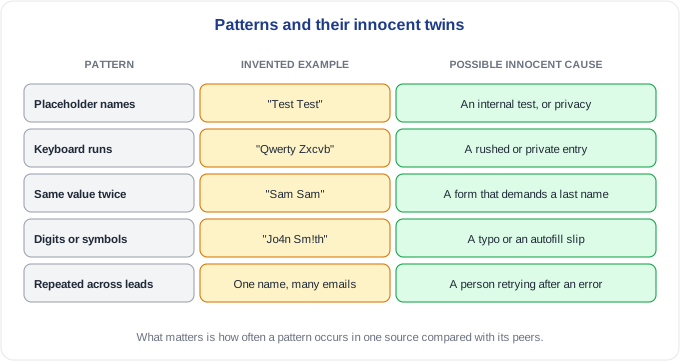
Someone typing "Test Test" may be a member of your own team checking the form, or a person who would rather not share their name. A keyboard run is often a rushed or private entry. The same value in both boxes can happen when a form insists on a last name and the person has only one name. A digit or a stray symbol can be a typo or an autofill slip. And one name appearing several times with different emails may be a person who tried again after an error.
None of these is a reason to reject a lead on its own. What matters is how often a pattern occurs within one source, compared with how often it occurs in others.
Why one odd name proves very little
A single strange entry is common in any honest stream of leads. A source where a large share of entries are placeholders, or where the same entries repeat, is different.
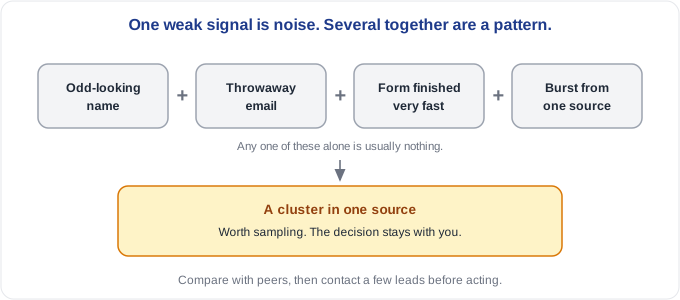
Each signal on the top row is weak. Together, in the same source and the same hour, they are a pattern, and a pattern is worth sampling. The disposable email checklist covers the email side, and the bot lead article covers form speed. The time-of-day article explains how to read a burst.
A fair way to check a source
- Tidy the field first. Trim spaces and make the case consistent before you compare, so that "SAM", "sam" and " Sam " match. This is the name equivalent of the approach in the email normalization guide.
- Count placeholders per source. Make a short list of obvious placeholders and runs of keys, then count what share of each source's leads contain one.
- Count repeats per source. How many leads share the same full name, and how many different emails sit behind them?
- Compare with peers. A source whose share is far above other sources on the same offer deserves a look. A share that is close to everyone else's is just the background noise of web forms.
- Sample the leads. Contact a handful from the odd group and a handful from a healthy source. What happens after contact settles it.
A name that does not match the email address is a weak clue, so do not lean on it. People use work addresses, shared inboxes, old accounts and nicknames, and a mismatch is common in perfectly real leads.
How this fits with other checks
Names are one of several fields that a script has to fill in, and the other fields usually give it away more clearly. The same-phone article shows how a shared phone number with different names can point to a ring. The field guide to types of lead fraud lists the patterns by group and shows at which level each is visible. And the affiliate scorecard guide shows where a placeholder-name share belongs in a monthly review.
What to do when a source stands out
- Ask the partner. A form may be forcing a field that people do not want to fill in, which pushes honest people towards placeholders. Fixing the form can help more than rejecting leads.
- Reject only on clear grounds. An agreement can list obviously fictitious values as a reason to reject a lead, and give an example. The agreement template guide has sample wording.
- Give a reason with each rejection. The lead scrubbing guide explains how, so the conversation with the partner stays factual. A flag means a lead deserves a closer look, and the decision stays with you.
- Handle names with care. Names are personal data. Ask counsel what applies to how you store, share and discuss them, and avoid circulating lists of names outside the people who need them.
A short checklist
- Look for patterns in the entry, not for unusual names.
- Never flag short, single, hyphenated, accented or culturally unfamiliar names.
- Tidy case and spaces before comparing.
- Count placeholders and repeats per source.
- Compare with peers on the same offer.
- Combine with email, timing and burst checks.
- Sample before you reject, and give a reason.
See what your own export shows
If you would like to see which of your leads trip this and our other checks, send us a recent lead export and we will run every lead through our checks and email you a report showing which ones look suspicious and why, at no cost. A flag means a lead deserves a closer look, and the decision stays with you.
Frequently asked questions
Can you tell a fake lead from the name alone? Not reliably. Placeholders and repeats are worth noticing, but a name on its own is weak evidence. Combine it with other signals and check outcomes.
Should I flag unusual or foreign-sounding names? No. An unfamiliar name is not a signal, and treating it as one is unfair and costly. Look at how the field was filled in, not at how the name sounds.
What are common placeholder names? Repeated words such as "test", runs of keys such as "asdf", generic stand-ins and obviously fictional characters. Count them per source and compare with peers.
Why does the same name appear with different emails? A person may retry a form, use several addresses, or a script may be drawing from a list. Look at timing, sources and how the leads turned out.
Should a name that does not match the email be rejected? No. Mismatches are common in real leads. Treat it as a weak clue at most.
Look at how a field was filled in, not at whose name it is, and let the combination of signals decide.